
HS Codes for Industrial Minerals: Export Paperwork and Classification
HS codes for industrial minerals depend on the exact product, its processing state and the customs tariff used by each country. This guide explains how to classify talc, antimony, copper, soda ash, lithium carbonate and other materials, then keep one approved product identity across the commercial invoice, packing list, customs declaration, certificate of origin and transport documents.
Article navigation
Use the six-digit HS code as the international starting point. Always confirm the full national tariff line in both the export and import countries. Before choosing a code, verify the composition, processing method, physical form and commercial identity. Once approved, keep the code and product description consistent across customs, banking and transport documents.
How HS codes for industrial minerals are structured
At the international level, the World Customs Organization Harmonized System uses chapters, four-digit headings and six-digit subheadings. The six-digit level is the last internationally harmonized legal level. Countries may then add digits for duty, licensing and statistics.
| Level | Example | Meaning | Control point |
|---|---|---|---|
| Chapter | 25 | Salt, sulphur, earths, stone and related mineral products. | Broad material family. |
| Heading | 2526 | Natural steatite and talc. | Legal heading text and chapter notes. |
| HS subheading | 252620 | Crushed or powdered natural steatite and talc. | International six-digit classification. |
| UAE tariff line | 25262020 | Crushed or powdered talc in the UAE tariff. | National eight-digit tariff line. |
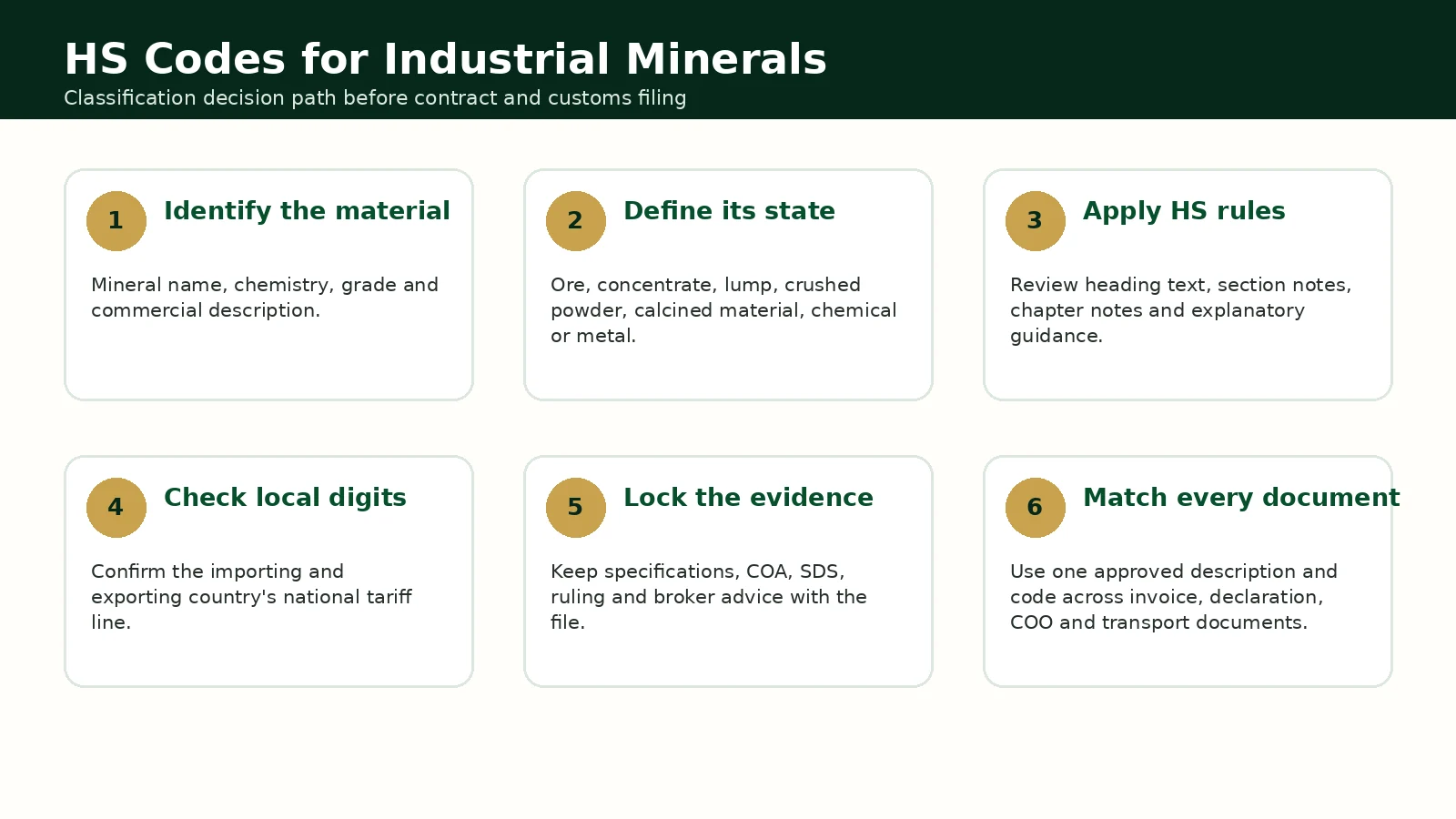
Industrial mineral HS code classification workflow
- Identify the material. Record the mineral, chemical composition, purity, grade and commercial use.
- Define the physical state. Note whether it is lump, crushed, powdered, slurry, ore, concentrate, calcined, refined metal or a prepared mixture.
- Review the legal text. Apply the heading wording, section notes, chapter notes and relevant explanatory material.
- Compare candidate headings. Do not stop at the first code containing a familiar product word.
- Confirm local tariff lines. Check the exporting and importing countries’ current tariff databases.
- Seek a ruling where risk is material. Use a binding or advance classification decision where available.
- Lock the classification file. Approve the code, description, evidence, effective date and change triggers.
HS code quick reference for common industrial minerals and metals
This table gives the international six-digit starting point for frequently traded AHR materials. Match the code to the exact product state, confirm the national extension and document the classification evidence before filing.
Natural minerals, ores and concentrates
| Commodity | Typical form or specification | HS code | Notes and national extensions |
|---|---|---|---|
| Talc / natural steatite | Not crushed and not powdered | 252610 | The EU Combined Nomenclature commonly extends this to 25261000. |
| Talc / natural steatite | Crushed or powdered, including fine filler grades | 252620 | The EU commonly uses 25262000. The UAE tariff further separates talc and steatite. |
| Antimony | Ores and concentrates | 261710 | Code 260600 is for aluminium ores and concentrates and must not be used for antimony. |
| Antimony | Unwrought metal or powder, including qualifying ingot form | 811010 | National extensions may appear as 81101000. |
| Antimony | Other antimony articles | 811090 | Use only when the product is an article covered by the residual subheading. |
Processed chemicals, metals and worked forms
| Commodity | Typical form or specification | HS code | Notes and national extensions |
|---|---|---|---|
| Antimony trioxide | Antimony oxide powder, including Sb2O3 when composition fits | 282580 | Confirm purity, composition and national chemical controls. |
| Copper | Ores and concentrates | 260300 | Do not use this code for blister copper, anodes or refined cathodes. |
| Copper | Unrefined copper, including blister copper and qualifying anodes | 740200 | Confirm the metallurgy and physical form. |
| Refined copper | Cathodes and sections of cathodes | 740311 | Other refined unwrought forms use different subheadings. |
| Lithium-bearing material | Spodumene, lepidolite or another lithium ore or concentrate | 261790 | Support the residual classification with assay and mineralogy. |
| Lithium oxide or hydroxide | Chemical product | 282520 | Confirm whether the product is oxide, hydroxide, solution or preparation. |
| Lithium carbonate | Technical, industrial or battery-grade lithium carbonate | 283691 | Grade normally does not change the six-digit classification. |
| Barite / barytes | Natural barium sulphate, whether or not ground | 251110 | Code 251120 is natural barium carbonate, or witherite. |
| Natural barium carbonate | Witherite | 251120 | Chemically produced barium compounds may classify in Chapter 28. |
| Calcium carbonate | Chemically defined calcium carbonate | 283650 | Natural chalk, limestone, marble and mixtures require separate review. |
| Limestone | Limestone flux and calcareous stone used for lime or cement manufacture | 252100 | Not a universal code for every natural calcium carbonate product. |
| Gypsum / anhydrite | Natural gypsum or anhydrite | 252010 | National tariffs may divide gypsum and anhydrite below six digits. |
| Plaster | Calcined gypsum or calcium-sulphate plaster | 252020 | Additives or prepared construction products may require another code. |
| Graphite | Natural graphite in powder or flakes | 250410 | Synthetic graphite is classified separately under 380110. |
| Manganese | Ores and concentrates | 260200 | Verify manganese content and product state. |
| Marble | Crude or roughly trimmed marble and travertine | 251511 | Worked marble articles and finished stone move to Chapter 68. |
- Start with the international six-digit code.
- Confirm the national 8, 10 or 12-digit extension.
- Match the code to the material state.
- Keep the specification, COA, SDS, photographs and processing description.
- Obtain professional confirmation where duty or compliance risk is material.
Why product state changes the customs code
| Question | Why it changes classification | Evidence to keep |
|---|---|---|
| Natural mineral or chemical? | Natural calcium carbonate and chemically produced calcium carbonate may fall in different chapters. | Manufacturing flow, chemistry, mineralogy and specification. |
| Ore, concentrate or refined metal? | Antimony concentrate and antimony ingot belong to different headings. | Assay, beneficiation record, photographs and description. |
| Lump or powder? | Talc is divided between not crushed/not powdered and crushed/powdered subheadings. | Particle-size data, packing form and production record. |
| Calcined or processed? | Processing does not automatically move every mineral to Chapter 68. | Temperature, process purpose, chemical changes and final use. |
| Pure substance or mixture? | A blend with binders, coatings or additives may become a prepared product. | Full formulation, SDS composition and treatment declaration. |
| Material or finished article? | A mineral slab, ceramic article or component may no longer classify as raw mineral material. | Dimensions, drawings, photographs and finished use. |
Export paperwork for industrial mineral shipments
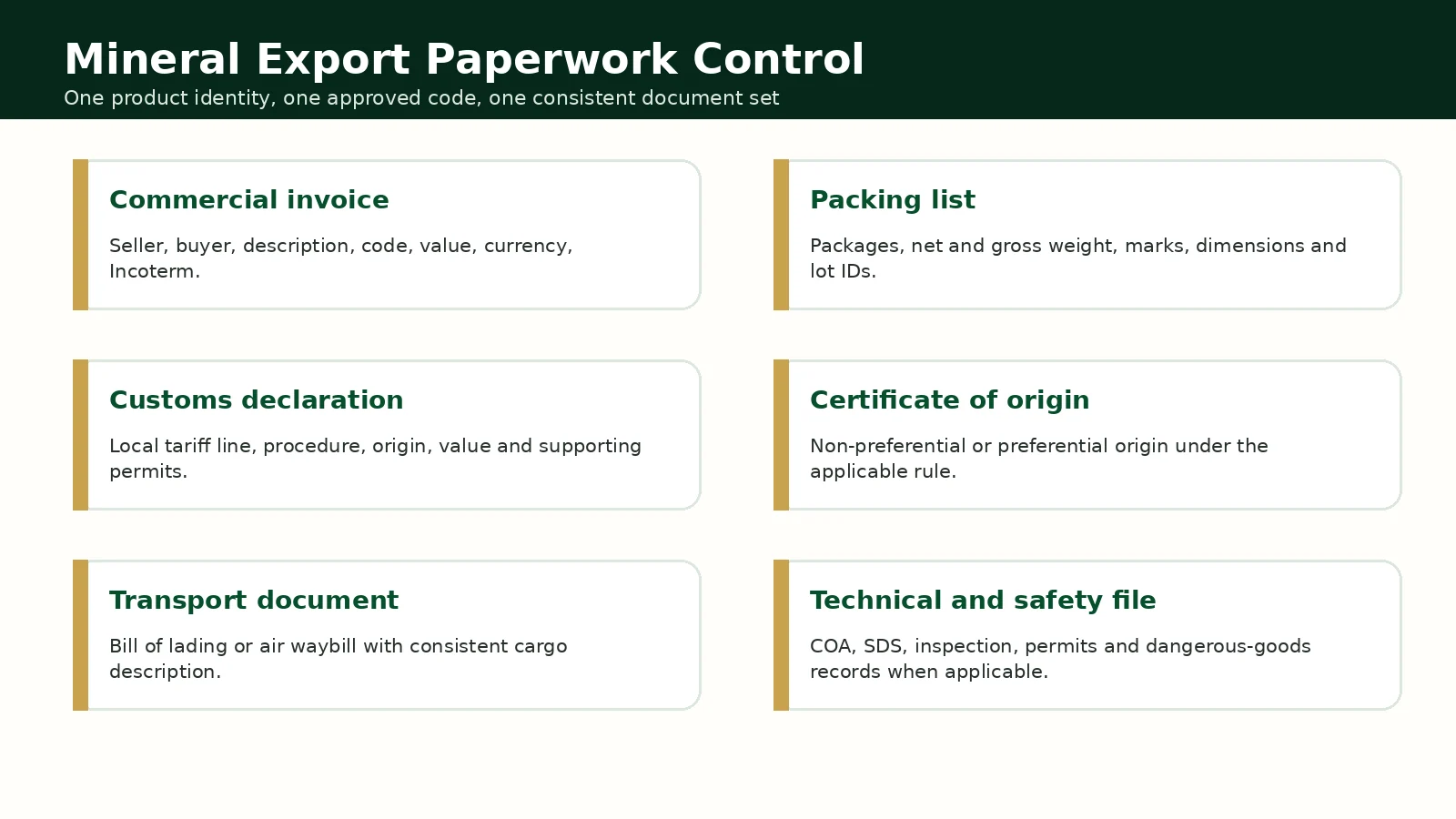
The exact file depends on the product, country, Incoterm, payment method and transport mode. Most commercial shipments begin with the following controlled documents.
| Document | Core data | Control rule |
|---|---|---|
| Commercial invoice | Seller, buyer, description, HS code, quantity, value, currency, Incoterm, payment and origin. | Use the contract description and approved code. |
| Packing list | Packages, marks, lot IDs, net weight, gross weight, dimensions and pallet count. | Totals must reconcile with the invoice and transport document. |
| Customs declaration | Local tariff code, procedure, origin, value, quantity, permits and declarant details. | Review the broker entry before submission. |
| Certificate of origin | Exporter, consignee, goods, code, origin and preference basis. | Do not claim preference without satisfying the rule. |
| Bill of lading or air waybill | Shipper, consignee, cargo description, packages, weight, ports and freight terms. | Avoid vague descriptions that conflict with the declaration. |
| Certificate of analysis | Grade, lot, assay, moisture, PSD and contract tests. | Technical evidence should support the declared identity. |
| Safety data sheet | Hazards, composition, handling, transport and emergency information. | Transport classification must follow the actual material. |
| Insurance document | Insured party, voyage, value, risks and policy terms. | Required where the contract places insurance on the seller. |
| Inspection or weight certificate | Quantity, quality, seal, loading or survey findings. | Use when required by contract, LC, buyer or authority. |
How to keep HS codes consistent across export documents
| Data field | Invoice | Packing list | Declaration | COO | B/L or AWB |
|---|---|---|---|---|---|
| Description | Full commercial and technical wording | Same goods, shorter wording allowed | Tariff-compatible legal wording | Origin-compatible wording | Operational cargo wording |
| HS code | Approved code | Include when required | Full local tariff line | Code required by issuer | Only where required |
| Quantity | Commercial unit and total | Package and weight detail | Customs statistical unit | Certificate quantity | Transport quantity |
| Weight | Net or invoiced quantity | Net and gross | Declared net/gross | Must reconcile | Carrier weight |
| Origin | Country of origin | Optional but useful | Legal customs origin | Certified origin | Not a substitute for COO |
| Incoterm | Rule, named place and Incoterms 2020 | Usually not required | Used for value allocation | Usually not required | Freight wording must align |
Each document has a different legal function. Wording may be adapted, but product identity, quantity, origin and classification must not contradict each other.
How HS classification connects to certificate of origin
A certificate of origin supports the legal origin of the goods. Preferential duty normally requires compliance with a specific trade-agreement rule, not only shipment from a member country.
| Origin issue | Question to resolve | Evidence |
|---|---|---|
| Wholly obtained mineral | Was the mineral extracted in the stated country? | Mine licence, extraction records, supplier declaration and lot traceability. |
| Processed imported material | Did the processing meet the applicable origin rule? | Input origin, production flow, tariff shift or value-content calculation. |
| Re-export from UAE | Is the document proving UAE origin or only re-export status? | Import entry, re-export declaration and original origin evidence. |
| Preferential claim | Which agreement and product-specific rule apply? | Current agreement text, rule calculation and approved certificate. |
Why HS codes and dangerous-goods classification are separate
An HS code is a customs classification. The IMDG Code controls the safe maritime transport of dangerous goods in packaged form. A mineral shipment may have one HS code but require a separate transport assessment based on its actual hazards.
| Question | Customs file | Transport-safety file |
|---|---|---|
| What is the product? | HS heading, tariff line and description. | Composition, hazard data and physical form. |
| Is it dangerous goods? | The HS code alone does not decide. | Apply IMDG criteria and the Dangerous Goods List. |
| Does arsenic trigger UN 3077? | Not automatically. | Assess the mixture against environmental-hazard criteria. |
| Which documents are required? | Customs declaration and permits. | DG declaration, labels, marks and packaging where applicable. |
Do not declare antimony concentrate as UN 3077 only because arsenic exceeds a fixed percentage. Transport classification must follow the actual mixture and applicable criteria.
ISPM 15 requirements for mineral export packaging
ISPM 15 regulates solid wood packaging material in international trade. Compliant wood packaging is treated and marked under an authorised national system. Packaging made entirely from processed wood products such as plywood or fibreboard may be outside the treatment and marking scope.
Worked classification and paperwork examples
Natural talc powder in bulk bags
Confirm that the material is natural talc and remains crushed or powdered mineral material rather than a prepared mixture. The six-digit starting point is 252620. In the UAE tariff, talc is shown under 25262020.
Antimony concentrate
Antimony ores and concentrates use 261710, with UAE reference 26171000. Heading 2606 covers aluminium ores and concentrates.
Refined copper cathodes
Refined copper cathodes use 740311, with UAE reference 74031100. Control grade, bundle count, net weight, assay and lot identification.
Soda ash dense or light
Disodium carbonate uses 283620, with UAE reference 28362000. Dense and light grades may share the same code, but specifications and packaging should distinguish the grade.
Common HS code and paperwork errors
| Error | Why it matters | Corrective action |
|---|---|---|
| Using antimony code 260600 | That heading covers aluminium ores and concentrates. | Review 261710. |
| Using one code for ore, concentrate and metal | The product state and chapter can change. | Create separate approved classifications. |
| Assuming calcination always moves talc to Chapter 68 | Processing alone does not establish the heading. | Review legal text and transformation. |
| Different descriptions on invoice and declaration | Customs may question identity, value or origin. | Use an approved description matrix. |
| Claiming preferential origin without a rule file | The importer may lose preference. | Keep the agreement, rule and calculation. |
| Calling cargo dangerous goods from the HS code | Customs and transport systems answer different questions. | Complete a separate IMDG assessment. |
| Using an old local tariff code | National digits and controls can change. | Verify the tariff before each new trade lane. |
| Changing a declaration informally | Customs systems use controlled correction procedures. | Follow the formal amendment route. |
Pre-shipment document release checklist
HS codes for industrial minerals: frequently asked questions
Are the first six HS digits the same in every country?
The Harmonized System is standardised at six digits. Countries add national digits and may apply different controls.
What is the HS code for talc powder?
The common six-digit starting point for crushed or powdered natural talc is 252620. In the UAE tariff, talc is separated under 25262020.
What is the HS code for antimony ore or concentrate?
The six-digit subheading is 261710. The UAE reference is 26171000. Heading 2606 is for aluminium ores and concentrates.
Can the bill of lading use a shorter description?
Yes, where carrier systems require shorter wording. It must not contradict the declaration, invoice or certificate of origin.
Does the HS code decide whether cargo is dangerous goods?
No. Dangerous-goods classification requires a separate assessment under the applicable transport rules.
Do all pallets need an ISPM 15 certificate?
Solid wood packaging generally needs compliant treatment and marking where the destination applies ISPM 15.
Should the HS code be written in the sales contract?
It is useful to state the agreed code, but the contract should define responsibility for final import classification.
When should a binding classification ruling be requested?
Consider a ruling when duty exposure is material, competing headings exist or the product will move repeatedly through one customs territory.
Related trade and mineral resources
Authoritative references
World Customs Organization HS Convention: international use of six-digit Harmonized System codes.
UAE Unified Customs Tariff 2022: UAE national tariff lines used in the reference table.
UAE customs legal framework: customs declarations, invoices, origin and supporting documents.
ICC Incoterms 2020: official Incoterms rules.
International Maritime Organization IMDG overview: maritime dangerous-goods requirements.
IPPC ISPM 15: treatment and marking of wood packaging material.
Need a customs-ready mineral document set?
Send the product, composition, processing state, quantity, export country, destination, Incoterm, packaging and payment method. AHR can coordinate the technical and commercial file for broker review.