
How to Read a Talc Certificate of Analysis
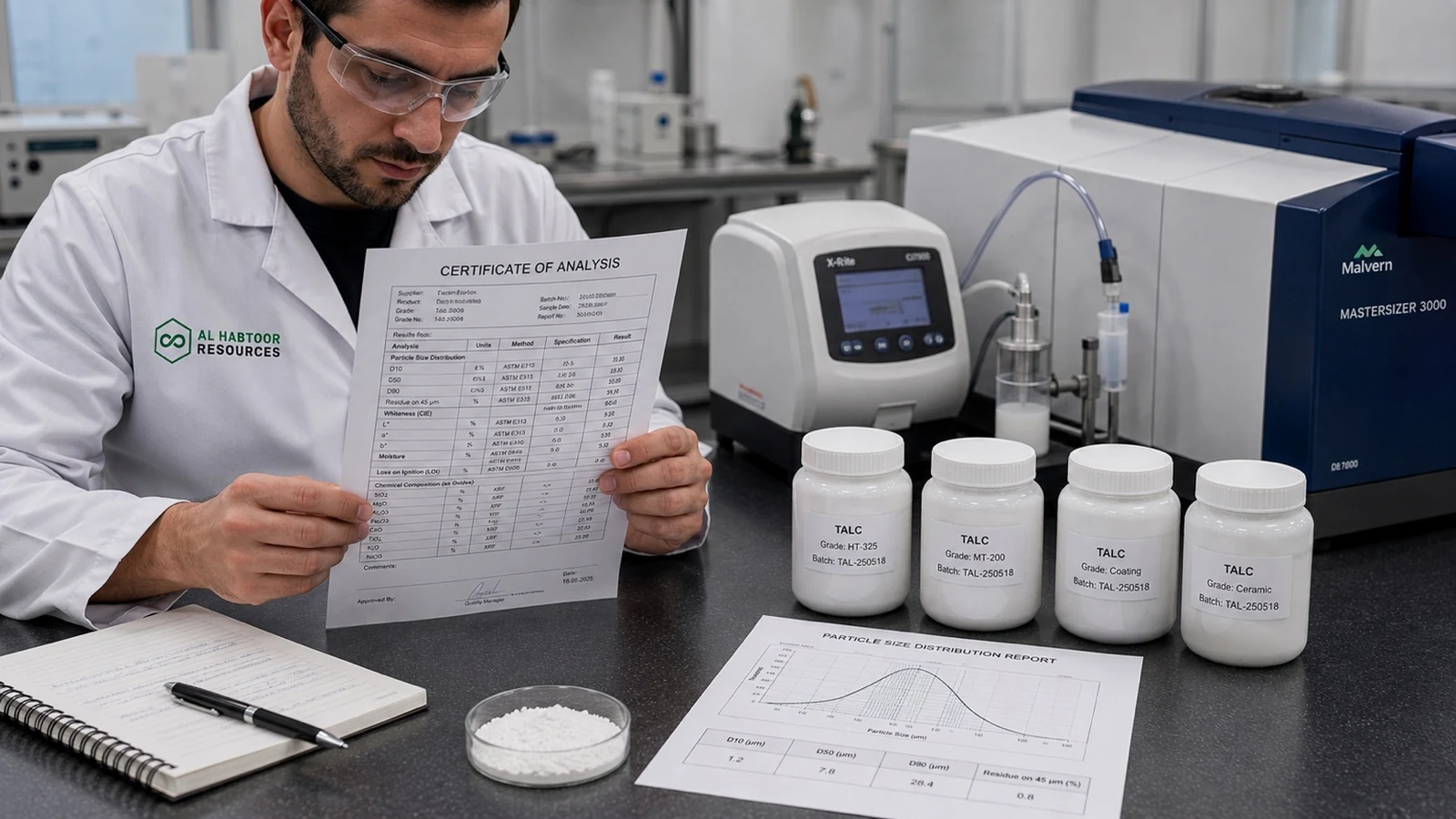
A talc Certificate of Analysis should connect one tested lot to an agreed specification. Therefore, buyers should verify identity, batch traceability, test methods, units, limits and approval status before accepting the document. This guide explains how to review particle size, whiteness, moisture, loss on ignition, chemistry, mineralogy and application-specific compliance.
Article navigationWhy a COA matters
A COA is useful only when it proves that the tested sample belongs to the supplied lot and that the laboratory used the agreed methods. A polished document without traceability does not support a reliable acceptance decision.
Why a talc COA matters
A Certificate of Analysis summarises laboratory results for a defined sample or production lot. In procurement, it supports three linked decisions: whether the material matches the ordered grade, whether the lot falls within agreed limits, and whether the document set is complete enough for release.
However, a COA does not replace the technical specification, Safety Data Sheet, regulatory declarations or independent verification where the application requires them. Instead, it should form one controlled part of the buyer’s approval process.
The anatomy of a procurement-ready talc COA
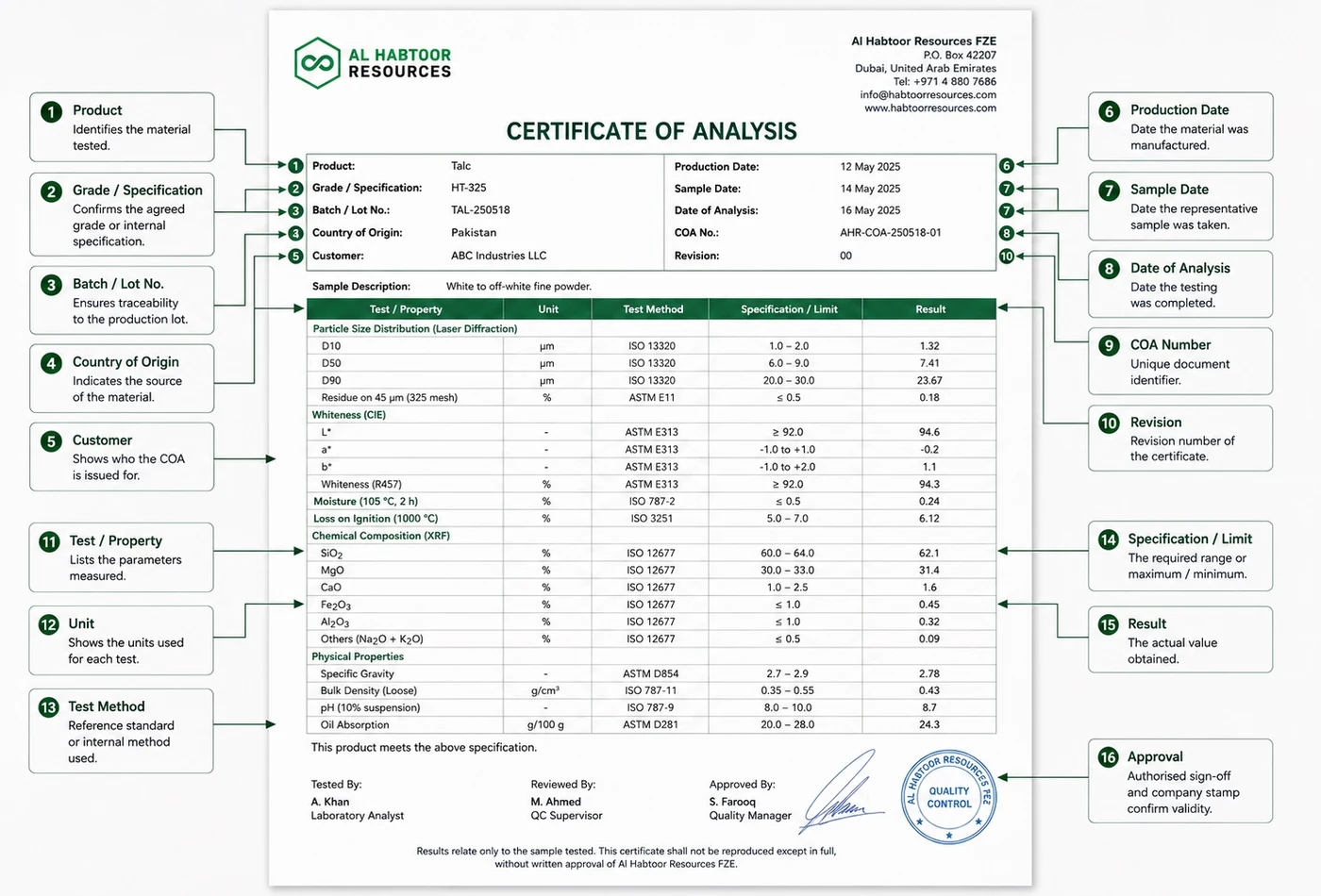
A strong COA uses a repeatable structure. First, it identifies the material and lot. Next, it lists test parameters, methods, units, results and limits. Finally, it records the test date, document revision and authorised approval.
| COA field | What the buyer should verify | Risk when missing |
|---|---|---|
| Supplier identity | Legal company name, site or laboratory and contact details. | The document may not show who produced or authorised it. |
| Product and grade | Exact commercial name, internal code and ordered grade. | The COA may relate to another specification. |
| Batch or lot | Unique identifier that matches bags, pallets and shipment records. | The result cannot be traced to the delivered material. |
| Sampling and test dates | Dates align with production and shipment timing. | An old or reused COA may pass unnoticed. |
| Test parameter | Each reported property has a clear name. | Ambiguous values may be interpreted incorrectly. |
| Method and unit | Named standard or controlled internal method plus complete units. | The buyer cannot compare or reproduce the result. |
| Specification limit | Minimum, maximum or range agrees with the purchase specification. | A numerical result may appear acceptable without a valid target. |
| Approval | Authorised name, role, signature or controlled electronic approval. | The document may lack formal release status. |
Start with identity and traceability
Before reviewing chemistry or particle size, match the COA to the commercial documents. The product code and grade should agree with the purchase order, packing list, bag label and invoice. Likewise, the batch number should appear consistently across the shipment.
A supplier sends the same undated COA for several shipments. Request a lot-specific document or a clear statement that the certificate represents a defined production campaign and identify the covered batches.
How to read particle size on a talc COA
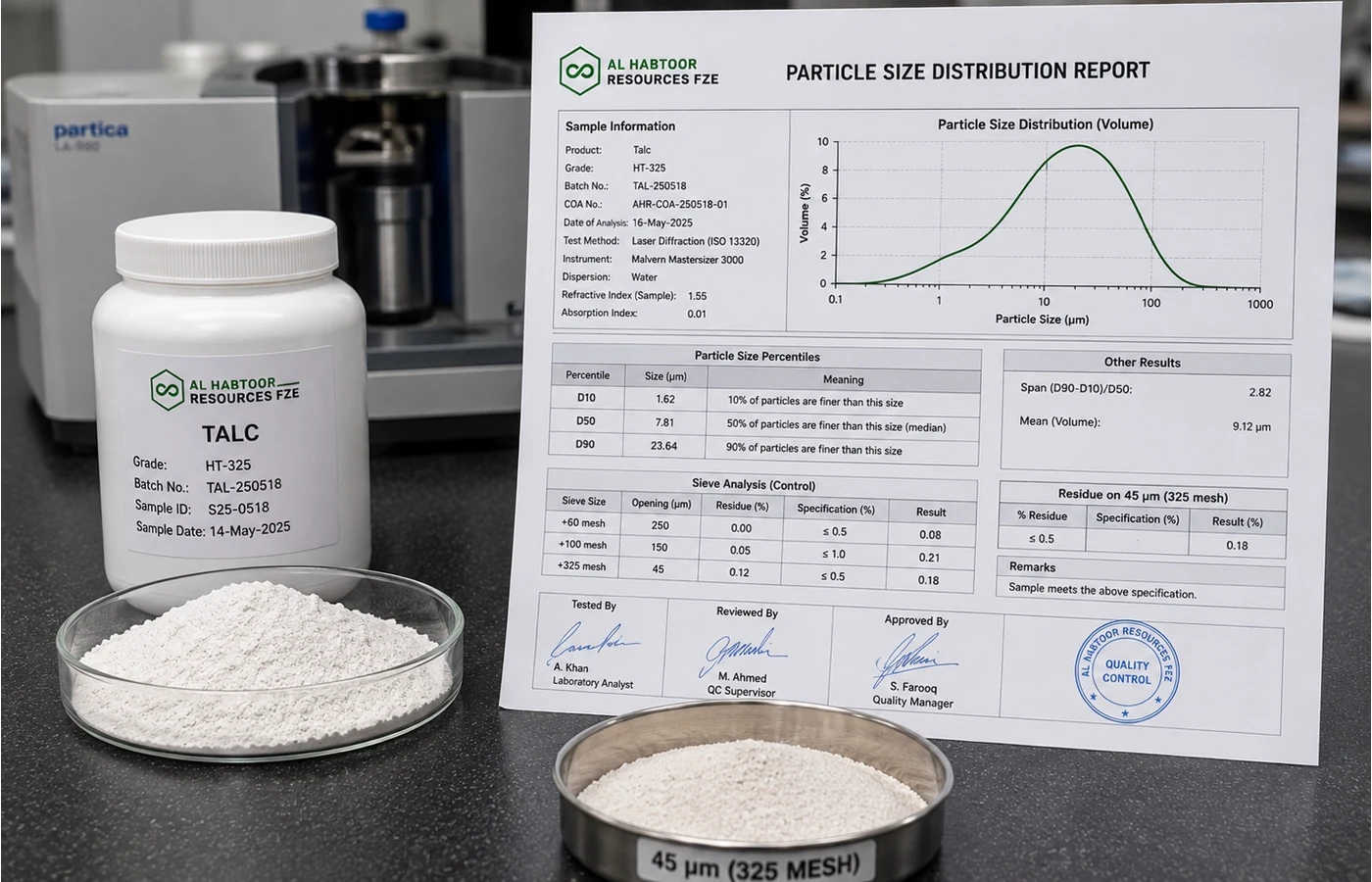
Talc suppliers may report sieve residue, percentage passing, D10, D50, D90 or a combination. Therefore, buyers should identify the method before comparing values. A mesh label alone does not describe the full particle size distribution.
| Reported field | What it means | What to verify |
|---|---|---|
| Sieve residue | Mass retained on a named nominal aperture. | Sieve designation, aperture, method, sample mass and maximum retained percentage. |
| Percentage passing | Mass that passes a named sieve. | Do not assume “325 mesh” means 100 percent passing unless the limit states it. |
| D10 | Size below which 10 percent of the stated distribution basis falls. | Distribution basis, dispersion route and instrument settings. |
| D50 | Median size, not the arithmetic average. | Use with D90 or residue to control the coarse tail. |
| D90 | Size below which 90 percent of the stated distribution basis falls. | Check whether the limit protects the application from oversize particles. |
Laser diffraction and sieve analysis answer different questions. Consequently, the buyer should not replace an approved sieve-residue limit with a laser D90 value unless a validated correlation exists for the grade.
Whiteness, brightness and CIELAB colour values
A COA may report whiteness index, brightness, L*, a*, b* or yellowness index. These terms are not interchangeable. Therefore, the document should identify the calculation method, instrument geometry, illuminant, observer, ultraviolet condition and specimen preparation.
| Parameter | Buyer interpretation | Required context |
|---|---|---|
| Whiteness index | Calculated indication of preferred white appearance for suitable same-material comparisons. | Named calculation, illuminant, observer, geometry and preparation. |
| Brightness | Reflectance under a defined spectral condition. | Exact brightness method and wavelength condition. |
| L* | Perceptual lightness. | Review with a* and b*, not alone. |
| a* | Green-red direction. | Useful for subtle lot colour shifts. |
| b* | Blue-yellow direction. | Positive movement can indicate a warmer or more yellow appearance. |
For a colour-sensitive application, compare the lot with an approved reference under matched conditions. In addition, set realistic tolerances that exceed normal method repeatability.
Moisture and loss on ignition are different
Moisture measures water removed under a stated drying or water-determination procedure. By contrast, loss on ignition records mass lost after heating under specified conditions and may include moisture, carbonates, hydroxyl-related loss or other volatile components depending on temperature and mineral composition.
LOI can support mineral and process review, but it does not identify which component caused the mass loss. Use chemistry and mineralogy when the cause matters.
Chemistry and mineralogy
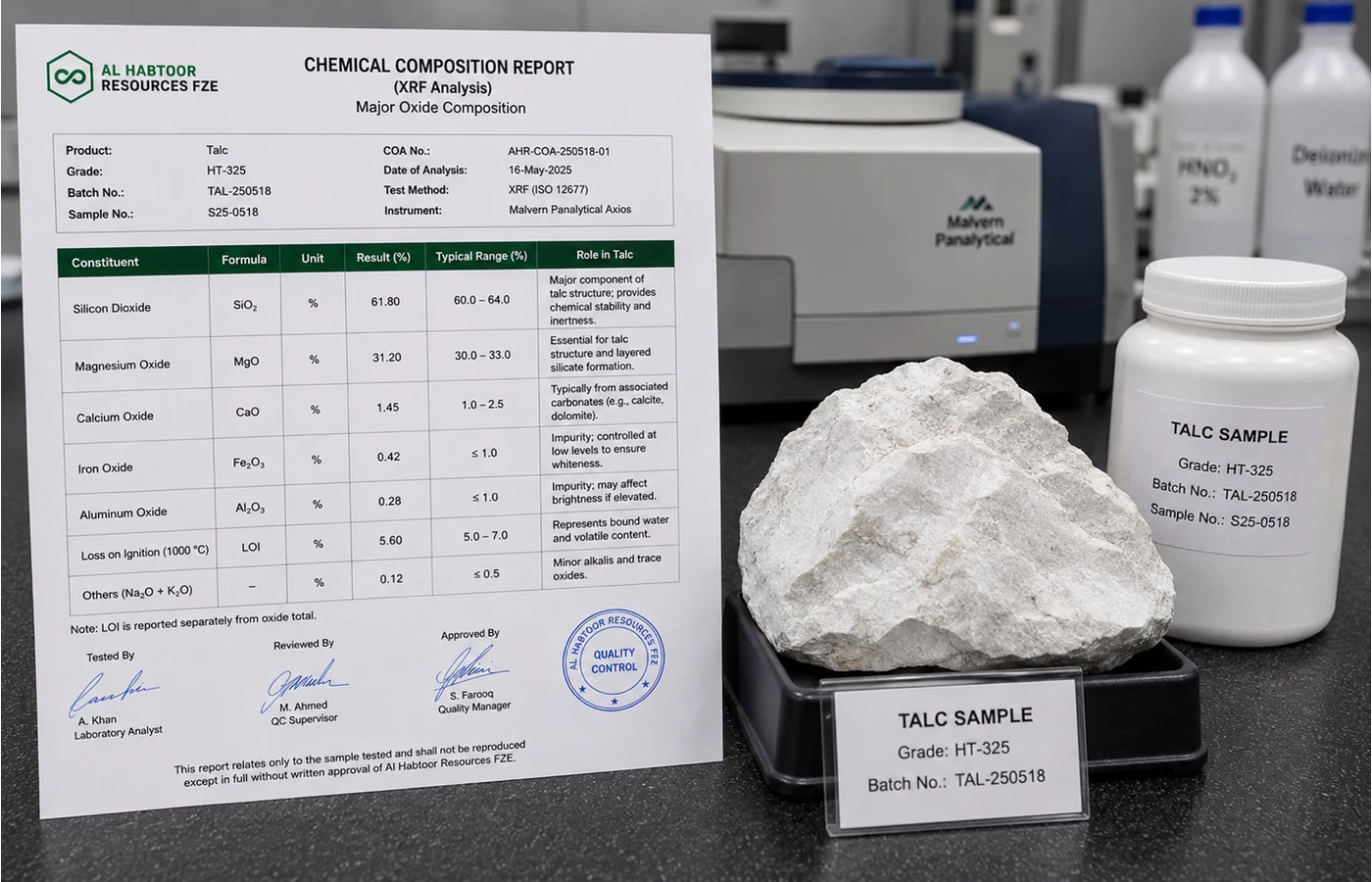
Many talc COAs report major oxides such as SiO2, MgO, CaO, Fe2O3 and Al2O3. These values help the buyer compare lots and identify changes in associated minerals. However, oxide chemistry does not directly equal talc mineral percentage.
| Parameter | What it may indicate | Buyer question |
|---|---|---|
| SiO2 | Silicate content from talc and associated silicate minerals. | Does the mineralogical report distinguish talc from quartz or other silicates? |
| MgO | Magnesium-bearing minerals such as talc, magnesite, dolomite or chlorite. | Is the value consistent with the approved source and grade? |
| CaO | May reflect carbonate minerals such as calcite or dolomite. | Does the application tolerate the associated carbonate level? |
| Fe2O3 | Iron-bearing minerals or trace contamination that may affect colour. | Does the result align with whiteness and application limits? |
| Al2O3 | May indicate chlorite, clay or other aluminosilicate minerals. | Is the value within the agreed source profile? |
When mineral identity matters, request a mineralogical method such as X-ray diffraction together with the reporting approach and detection limitations. For asbestos-related review, use an application-appropriate, documented laboratory protocol rather than relying on chemistry alone.
Physical properties and application-specific tests
Not every talc grade needs the same physical tests. Instead, choose parameters that predict performance in the target process. For example, plastics may prioritise particle size, colour, moisture and dispersion, while coatings may also require oil absorption and paint-pigment specifications.
| Property | Why buyers use it | Review point |
|---|---|---|
| Bulk density | Supports bag fill, feeding, storage and formulation volume calculations. | Confirm loose or tapped procedure. |
| Specific gravity | Supports formulation and density calculations. | Check method and temperature. |
| Oil absorption | Helps assess binder demand in coatings and related systems. | Use the agreed test method and endpoint. |
| pH | Supports compatibility review in aqueous or sensitive formulations. | Check suspension concentration and test procedure. |
| Hardness or abrasion proxy | Helps assess wear or contaminant risk where relevant. | Use an application-specific method rather than a generic claim. |
ASTM D605 covers magnesium silicate pigment used as paint-pigment-quality talc, while ASTM D717 provides chemical analysis methods for magnesium silicate pigment. Therefore, these standards may support paint and coating specifications, but they do not automatically define requirements for every talc application.
COA versus compliance and safety documents
A COA reports measured lot properties. By contrast, regulatory declarations and safety documents address market, hazard or application requirements. Do not assume that one document substitutes for the others.
| Document | Primary purpose | Buyer check |
|---|---|---|
| COA | Reports test results for a defined sample or lot. | Lot, methods, units, limits and approval. |
| Technical Data Sheet | Describes typical product properties and recommended uses. | Do not treat typical values as lot-specific results. |
| Safety Data Sheet | Communicates hazard, handling, storage and emergency information. | Current revision, jurisdiction and product identity. |
| REACH or market declaration | Addresses regulatory status or supply-chain obligations for a market. | Entity, substance identity, scope and date. |
| Application declaration | Addresses requirements such as restricted substances or industry-specific limits. | Confirm that the declaration covers the exact grade and intended use. |
REACH establishes the European Union framework for registration, evaluation, authorisation and restriction of chemicals. Nevertheless, the supplier’s obligations and the buyer’s required evidence depend on role, tonnage, substance identity and use. Therefore, procurement teams should request application-specific documents rather than generic claims such as “REACH approved.”
Buyer review checklist
Use the checklist before releasing a talc lot. If a critical field is missing, place the document under review rather than assuming compliance.
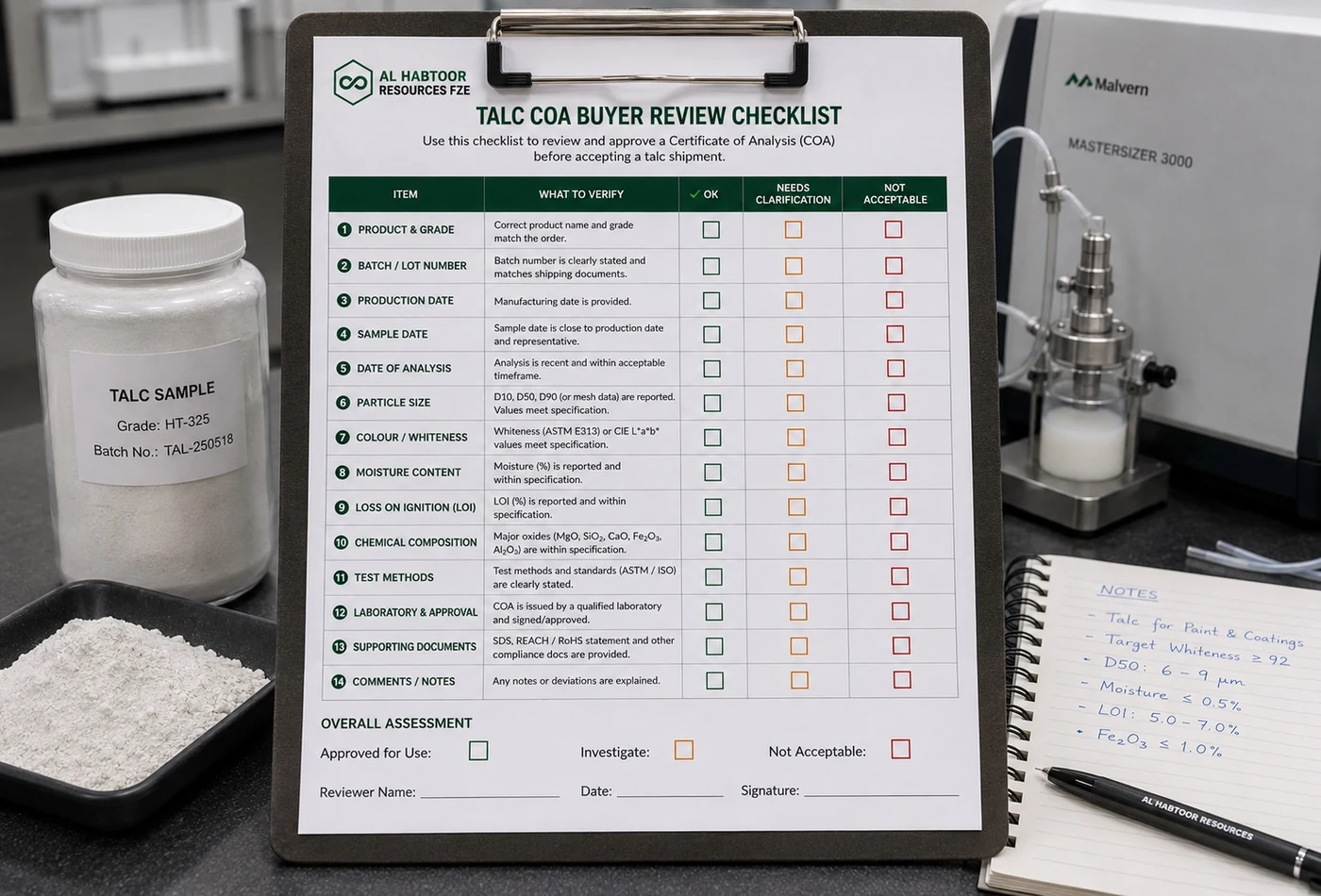
Quick COA request template
Use this structure when requesting pre-shipment documents or a revised certificate.
Required COA fields
Worked acceptance example
A buyer receives three document scenarios for the same talc order. The decision should reflect both numerical conformity and document reliability.
| Scenario | Finding | Decision | Action |
|---|---|---|---|
| A | Batch matches shipment; all critical results meet limits; methods and approval are present. | Accept | Release according to the buyer’s quality procedure. |
| B | Values meet limits, but the document has no batch number and uses an old test date. | Investigate | Request a corrected lot-specific COA before release. |
| C | D90 exceeds the approved maximum and the supplier reports no authorised deviation. | Reject | Quarantine the lot and follow the agreed non-conformance process. |
Decision principle
Accept only when the document is traceable and the critical values meet the approved specification. Investigate incomplete or contradictory evidence. Reject or quarantine material when a critical limit fails and no authorised concession exists.
Common supplier document problems
| Problem | Why it matters | Corrective request |
|---|---|---|
| No batch number | The result cannot be connected to the shipment. | Issue a lot-specific controlled COA. |
| Method listed as “internal” | The buyer cannot understand comparability. | Provide the method code, principle, revision and validation basis. |
| Result without unit | The number may be misinterpreted. | Add the complete unit and calculation basis. |
| No specification limits | Conformity is unclear. | Show the agreed minimum, maximum or range. |
| Old test date | The COA may represent another lot. | Confirm the covered batch or repeat the testing. |
| Different product name | The certificate may relate to another grade. | Align product identity across all documents. |
| No approval | Formal release status is unclear. | Add authorised electronic or signed approval. |
| Typical values presented as results | A technical data sheet may be mistaken for lot data. | Separate typical product data from measured batch results. |
Frequently asked questions
Is a talc COA the same as a specification?
No. The specification defines the agreed requirements. The COA reports results for a sample or lot and should compare those results with the specification.
Should every shipment have a new COA?
The document should cover the actual supplied batch or clearly defined production campaign. When a shipment contains several lots, the buyer may need a separate COA for each lot.
Can a buyer approve talc from D50 alone?
Usually not for a size-sensitive application. D50 does not control the fine or coarse tails. Review D10, D90 and direct sieve residue where relevant.
Does high SiO2 prove high talc purity?
No. Quartz and other silicate minerals can also contribute SiO2. Use mineralogical evidence when talc percentage or phase identity matters.
Is loss on ignition the same as moisture?
No. Moisture targets water under a defined procedure, while LOI measures total mass loss under stated ignition conditions.
What should a whiteness result include?
Request the named index or colour coordinates, instrument geometry, illuminant, observer, ultraviolet condition and specimen preparation.
Can a generic REACH statement replace a COA?
No. A REACH statement addresses regulatory status or supply-chain obligations. A COA reports lot-specific test results.
When should a buyer request independent testing?
Use independent testing when the application, contract, risk level or non-conformance procedure requires verification beyond the supplier’s laboratory result.
What should happen when one result falls outside the limit?
Quarantine or hold the material according to the quality procedure. Then confirm the result, review sampling and testing, and require an authorised disposition before use.
How long should COAs be retained?
Retention should follow the buyer’s legal, contractual, quality-system and application requirements. Link the retained document to the batch and shipment records.
Related procurement resources
Technical references
ASTM D605-82(2019) specifies requirements for magnesium silicate pigment consisting substantially of natural hydrous magnesium silicate and processed to paint-pigment quality.
ASTM paint and pigment standards list ASTM D717-86(2020) for chemical analysis of magnesium silicate pigment.
Regulation (EC) No 1907/2006 establishes the European Union REACH framework for chemicals.
Need a reviewable talc document package?
Send the grade, application, target specification, quantity, destination and required documents. AHR can coordinate a specification-led review of COA fields, supporting documents and shipment requirements.