
Negotiating Mineral Offtake Agreements
A practical buyer and seller guide to the commercial, technical, payment, security and dispute terms that make long-term mineral supply agreements bankable, auditable and resilient.
Page navigation
A mineral offtake agreement should convert commercial expectations into measurable obligations. Define the exact product and grade, annual and shipment volumes, price formula, sampling and assay method, quality adjustments, delivery point, payment mechanics, credit support, title transfer, default remedies and dispute path. Avoid undefined market terms, unspecified indexes and penalties that cannot be calculated from the contract alone.
The seven-part mineral offtake negotiation framework
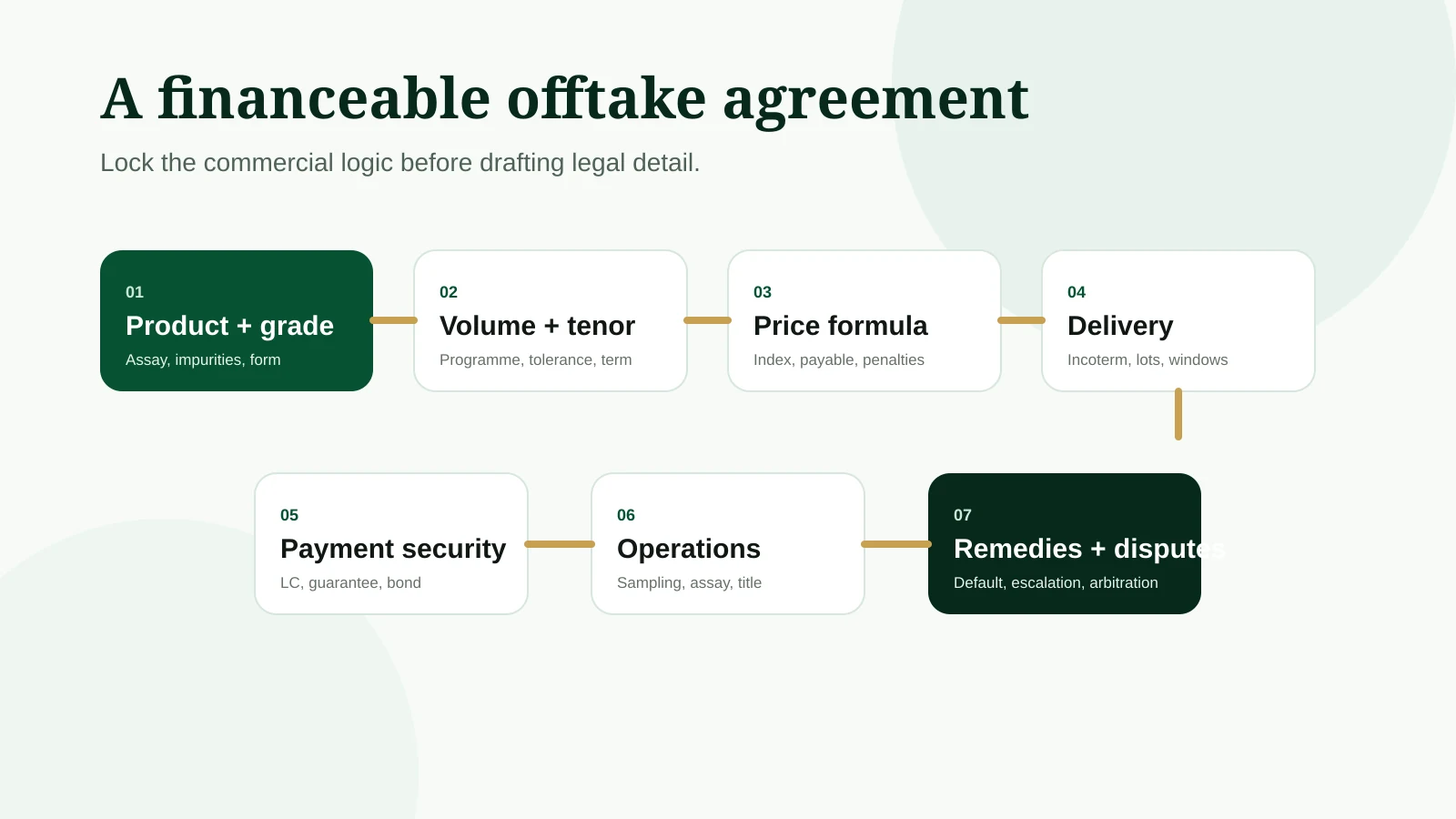
Agree the commercial backbone first
| Term | What must be fixed | Negotiation leverage | Drafting control |
|---|---|---|---|
| Product and grade | Exact mineral, physical form, HS starting point, assay limits, moisture, sizing and prohibited contaminants. | Use price adjustments for tolerable deviations and rejection only for material failures. | Attach a controlled specification schedule with units and test methods. |
| Annual quantity | Contract quantity, buyer and seller tolerance, minimum shipment and optional tonnes. | Separate firm volume from options and state who may exercise each option. | Define whether tolerance applies annually, monthly or per shipment. |
| Delivery programme | Nominations, forecast dates, shipment windows, acceptance and rescheduling. | Use workable windows rather than one unrealistic fixed day. | State notice periods, deemed acceptance and consequences of late changes. |
| Contract tenor | Effective date, initial term, extension, renewal and termination rights. | Longer term can support investment, but needs price and law review mechanisms. | Avoid automatic renewal without a notice deadline and revised commercial terms. |
| Exclusivity | Product, geography, customer group, minimum volume and carve-outs. | Link exclusivity to performance, payment and minimum purchase commitments. | Do not grant broad exclusivity without measurable conditions and expiry. |
Choose a price model that can be calculated without argument
| Model | Mechanism | Best fit | Main risk to control |
|---|---|---|---|
| Fixed price | Agreed currency amount per dry or wet metric tonne for a defined period. | Short terms, stable products and predictable logistics. | Market divergence, inflation and freight changes. |
| Index-linked | Published index or exchange price over a defined quotation period, adjusted by payable and deductions. | Metals and concentrates exposed to transparent market pricing. | Undefined source, timing, currency conversion or fallback when the index is unavailable. |
| Tiered payability | Payable percentage changes at stated grade bands. | Concentrates where higher grade creates measurable value. | Cliff effects at thresholds and inconsistent assay methods. |
| Floor and cap | Floating price is limited by a minimum and maximum. | Long-term supply where both parties need budget protection. | Collar reset dates, index discontinuation and abnormal market events. |
| Cost-plus | Verified cost base plus agreed margin or fee. | Dedicated production, tolling or development-stage supply. | Cost definitions, audit rights, inefficiency and affiliate charges. |
Gross reference value = dry tonnes x final assay x payable percentage x reference price
Net settlement = gross reference value - treatment charges - refining charges - impurity penalties + quality bonuses - agreed logistics or finance adjustments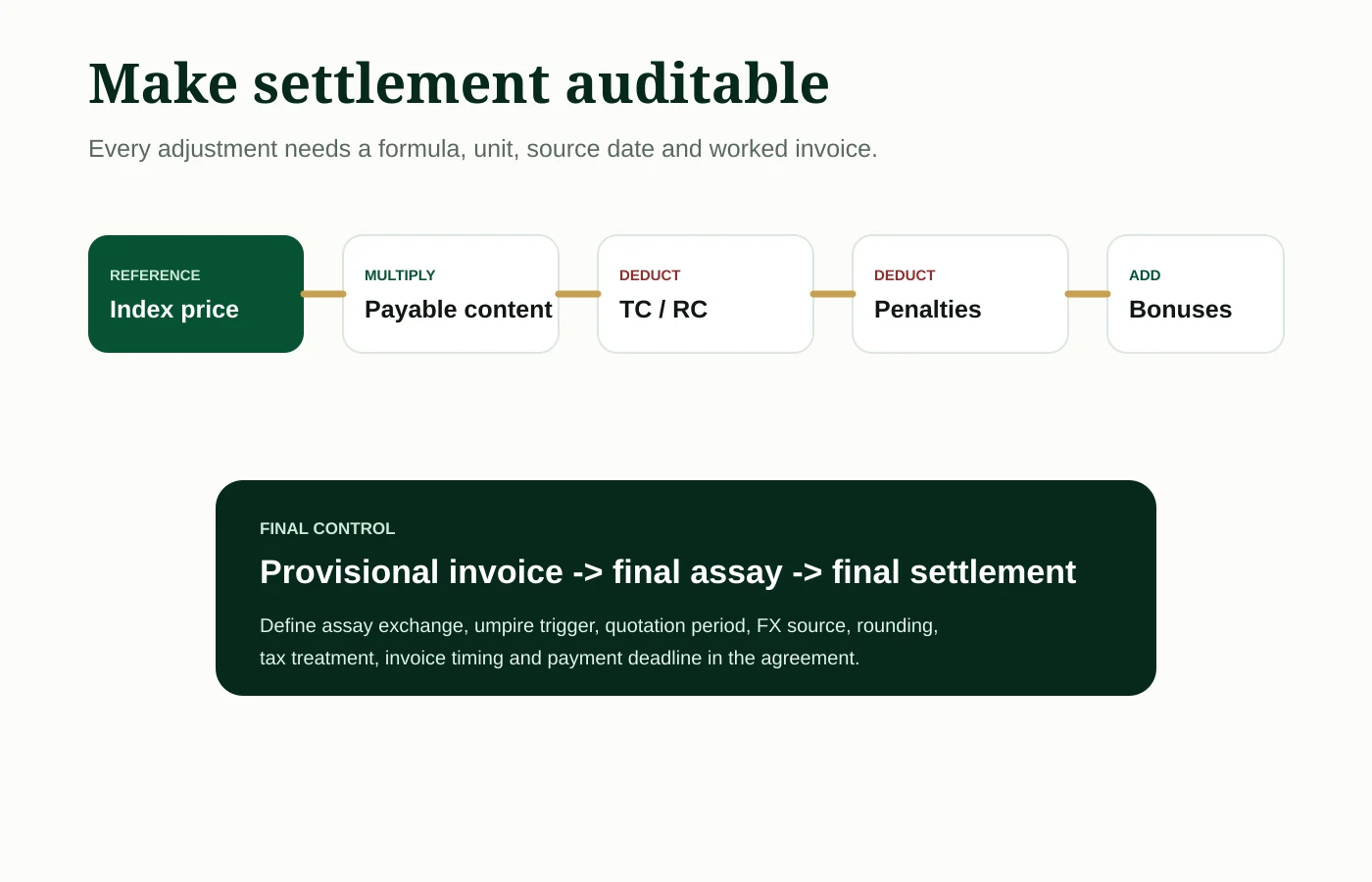
Build a quality, penalty and rejection matrix
Every material specification should lead to a defined commercial result. Separate target values, guaranteed limits, penalty thresholds and rejection levels. Do not use the same consequence for a minor deviation and a shipment that cannot be safely processed.
| Parameter | Target / guarantee | Penalty trigger | Adjustment method | Rejection or special handling |
|---|---|---|---|---|
| Payable mineral or metal | Minimum assay and test basis. | Below target but above rejection level. | Lower payable, price deduction or banded schedule. | Below absolute minimum or commercially unusable grade. |
| Moisture | Maximum free moisture and sampling method. | Above free allowance. | Dry-weight correction plus handling cost where agreed. | Unsafe, unhandleable or materially non-conforming cargo. |
| Arsenic / mercury | Maximum concentration and analytical method. | Above penalty-free threshold. | Currency amount per excess unit or treatment-cost pass-through. | Regulatory, smelter, transport or environmental limit exceeded. |
| Loss on ignition | Specified maximum or reporting requirement. | Above stated threshold. | Price deduction tied to process impact. | Where excess indicates a different or unsuitable material. |
| Particle size | Distribution and oversize limit. | Outside guaranteed band. | Reprocessing cost, discount or replacement. | Material cannot enter buyer process safely or efficiently. |
Define delivery, risk, title and scheduling separately
Use the selected Incoterms 2020 rule with a precise named place or port. Incoterms allocate specified delivery, cost and risk responsibilities, but they do not replace the sales contract or decide price, payment, title, quality remedies or dispute law.
Match payment security to the real exposure
| Structure | Typical commercial use | Seller protection | Buyer protection | Points to draft |
|---|---|---|---|---|
| Irrevocable documentary credit | New counterparties, cross-border supply and bankable document flows. | Bank undertaking subject to compliant presentation. | Payment against defined documents rather than an unsecured advance. | UCP 600 incorporation, issuing bank, confirmation, expiry, presentation place, documents and discrepancy process. |
| Cash against documents / DP | Established lanes where parties accept collection risk. | Control of specified documents until payment or acceptance. | Lower bank complexity than an LC. | Collection rules, document release, non-payment, storage and return cargo. |
| Open account | Strong repeat buyers with approved credit. | Guarantee, insurance, credit limit, retention or parent support. | Cash-flow benefit and simpler documents. | Credit cap, overdue interest, suspension rights and set-off restrictions. |
| Advance plus balance | Production reservation, custom packing or constrained supply. | Upfront working capital and commitment. | Balance retained until shipping or quality milestone. | Refund triggers, use of funds, milestone evidence and security. |
Security package
Operational clauses that prevent expensive ambiguity
Use a dispute ladder that separates technical and legal issues
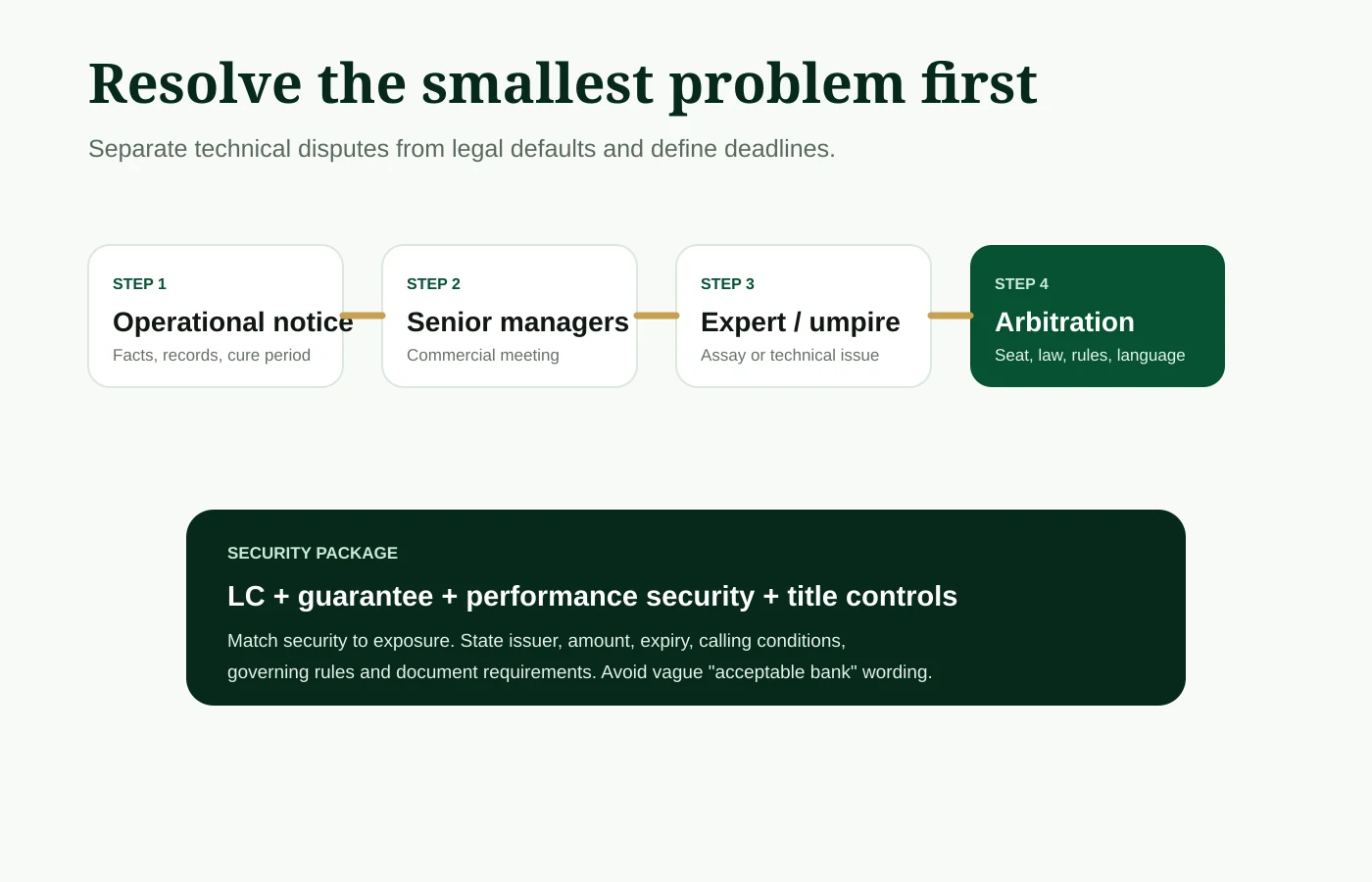
| Stage | Scope | Deadline | Decision status |
|---|---|---|---|
| Operational notice | Shipment, documents, payment, sampling or quality issue. | Prompt notice plus defined cure period. | Evidence preservation and operational resolution. |
| Senior management | Commercial settlement after operational escalation. | For example, meeting within 10 to 15 business days. | Written settlement only if authorised and signed. |
| Expert / umpire | Assay, weight, moisture, quality or calculation issues. | Defined appointment and report timetable. | State whether final and binding except manifest error. |
| Arbitration | Legal, contractual and unresolved commercial disputes. | According to selected rules and procedural orders. | Final award subject to the applicable arbitration framework. |
Offtake agreement negotiation checklist
Buyer and seller negotiation positions
| Topic | Buyer normally presses for | Seller normally presses for | Balanced control |
|---|---|---|---|
| Quality | Wider rejection rights and stronger penalties. | Narrow guarantees and cure or discount before rejection. | Separate tolerable deviation, penalty band and absolute rejection. |
| Volume | Flexibility, options and lower take commitment. | Firm nominations and take-or-pay protection. | Firm base volume plus priced options and make-up rules. |
| Price | Low payable, broad deductions and cap protection. | High payable, bonuses and floor protection. | Transparent index formula, collar and scheduled review. |
| Payment | Payment after final assay and document approval. | Advance or prompt provisional payment. | Provisional payment with limited final true-up and clear deadlines. |
| Logistics | Seller responsibility to destination and delay remedies. | Earlier delivery point and buyer-controlled freight. | Incoterm selected from operational capability, not habit. |
Mineral offtake agreement FAQ
What is a mineral offtake agreement?
It is a contract under which a buyer agrees to purchase and a seller agrees to supply a defined quantity of mineral product over a stated period under agreed pricing, quality, delivery, payment and risk terms.
What terms should be negotiated first?
Start with product and specification, committed volume, contract period, price formula, delivery point, payment structure and sampling or assay procedure. The remaining clauses should support this commercial model.
Should an offtake price be fixed or index-linked?
That depends on product liquidity, market transparency, tenor and risk appetite. Whatever model is selected, identify the source, quotation period, currency, fallback, adjustments and worked examples.
How should quality penalties be written?
Define the parameter, method, threshold, unit, monetary adjustment, calculation order, cap and rejection point. Avoid wording such as “market penalty” without an objective source.
Do Incoterms decide when ownership passes?
No. Incoterms allocate specified delivery, cost and risk responsibilities. The contract should address title transfer separately.
When is an LC useful?
A documentary credit can reduce payment exposure where the bank undertaking, document conditions and issuing or confirming bank are acceptable. The credit should be aligned with the contract and expressly subject to the agreed rules, commonly UCP 600.
Should assay disputes go directly to arbitration?
Usually not. A defined umpire-laboratory or expert-determination process is often faster for technical differences. Legal disputes can follow the agreed escalation and arbitration clause.
Is this page a contract template or legal advice?
No. It is a commercial negotiation guide. The final agreement should be drafted or reviewed by qualified legal, tax, sanctions, trade-finance and technical advisers for the parties and jurisdictions involved.
Related mineral trade resources
Authoritative references
ICC Incoterms 2020: official trade rules defining specified buyer and seller responsibilities for delivery, costs and risk.
ICC UCP 600: rules governing documentary credits when incorporated into the credit.
UNCITRAL New York Convention: recognition of arbitration agreements and enforcement of foreign and non-domestic arbitral awards.
LCIA Arbitration Rules 2020: current LCIA arbitration rules.
Planning a mineral supply or offtake programme?
Send the product, specification, annual volume, delivery route, target contract term, payment preference and required security. AHR can structure the commercial and technical supply file for legal and banking review.