
What Is Soda Ash? Uses, Properties & How It's Made
Soda ash is the common industrial name for sodium carbonate, Na₂CO₃ — a white, odourless, alkaline powder and one of the most widely used base chemicals in the world. It’s the workhorse behind glass, detergents and countless chemical processes. This guide covers what it is, how it’s produced, its properties, its two main grades, and where it’s used.
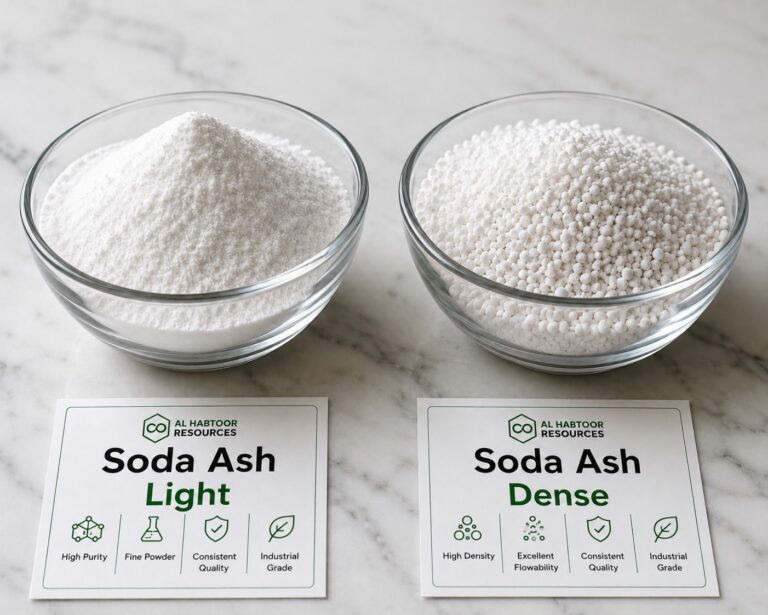
What Is Soda Ash?
Soda ash is sodium carbonate (Na₂CO₃), the sodium salt of carbonic acid. It’s a strong alkaline salt — a water solution sits around pH 11.6 — which is why it’s used to raise pH, soften water and react with acids. It’s also known as washing soda (the hydrated crystal form, Na₂CO₃·10H₂O) and disodium carbonate. It should not be confused with baking soda (sodium bicarbonate, NaHCO₃) or caustic soda (sodium hydroxide, NaOH).
| Property | Value |
|---|---|
| Chemical formula | Na₂CO₃ |
| Molar mass | 105.99 g/mol |
| Appearance | White, odourless powder |
| Melting point | 851 °C |
| Solubility | Highly soluble in water |
| pH (aqueous) | ~11.6 (strongly alkaline) |
| Other names | Washing soda, sodium carbonate, disodium carbonate |
How Is Soda Ash Made?
There are two routes — synthetic and natural.
The Solvay Process (synthetic)
The dominant industrial method. Salt brine (NaCl), limestone (CaCO₃) and ammonia are reacted to precipitate sodium bicarbonate, which is then heated (calcined) to drive off water and CO₂, leaving sodium carbonate. The ammonia is recovered and recycled.
From Trona Ore (natural)
Large natural deposits of trona (sodium sesquicarbonate) are mined — notably in Wyoming (USA) and Turkey — then crushed, calcined and purified into soda ash. Natural soda ash generally has a lower energy and emissions footprint than the Solvay route.

Properties of Soda Ash
- Alkaline — raises pH, neutralises acids, softens hard water.
- Hygroscopic — absorbs moisture, so it’s stored sealed and dry.
- Highly water-soluble — dissolves readily, releasing heat.
- High melting point (851 °C) — but it lowers the melting point of silica, which is the key to its use in glass.
- Stable and non-flammable — safe to store and transport as a dry solid.
Light vs Dense Soda Ash
Both are ≥99.2% Na₂CO₃ — the difference is physical, not chemical.
| Light soda ash | Dense soda ash | |
|---|---|---|
| Bulk density | ~0.5 g/cm³ | ~1.0 g/cm³ |
| Form | Fine powder | Coarse granules |
| Dust | Higher | Low |
| Best for | Detergents, chemicals, dyes | Glass, low-dust handling |
Dense grade is made by partially hydrating and re-drying light soda ash to build denser, larger particles that flow well and don’t segregate from sand in a glass batch.
What Is Soda Ash Used For?
- Glass (largest use, ~half of global demand) — flat glass, bottles and fibreglass. It lowers the melting point of sand, saving furnace energy.
- Detergents & soaps — water softening and alkaline building.
- Chemical manufacturing — feedstock for sodium silicate, sodium bicarbonate, chromates and phosphates.
- Water treatment — pH adjustment and hardness removal.
- Metallurgy & mining — pH control, flotation, desulphurisation.
- Pulp, paper & textiles — processing and dyeing.
- Food (E500) — acidity regulator and raising agent.
- Oilfield — drilling fluid treatment.
Soda Ash FAQ
Is soda ash dangerous? It’s not flammable or explosive, but it’s strongly alkaline — it can irritate skin, eyes and lungs. Handle with gloves, goggles and a dust mask, and store dry.
Soda ash vs baking soda — what’s the difference? Soda ash is sodium carbonate (Na₂CO₃); baking soda is sodium bicarbonate (NaHCO₃). Soda ash is far more alkaline and is an industrial chemical, not a food leavening agent.
Soda ash vs caustic soda? Caustic soda is sodium hydroxide (NaOH) — a much stronger, more hazardous base. Soda ash is milder and safer to handle.
Where can I buy soda ash in the UAE? Al Habtoor Resources supplies light and dense soda ash across the UAE and GCC.