
Talc Mixing: Dry Blending vs Compaction
A technical buyer guide comparing talc dry blending and compaction for dust behavior, bulk density, feeding, packing, documentation and industrial procurement decisions.

What dry blending and compaction mean in talc procurement
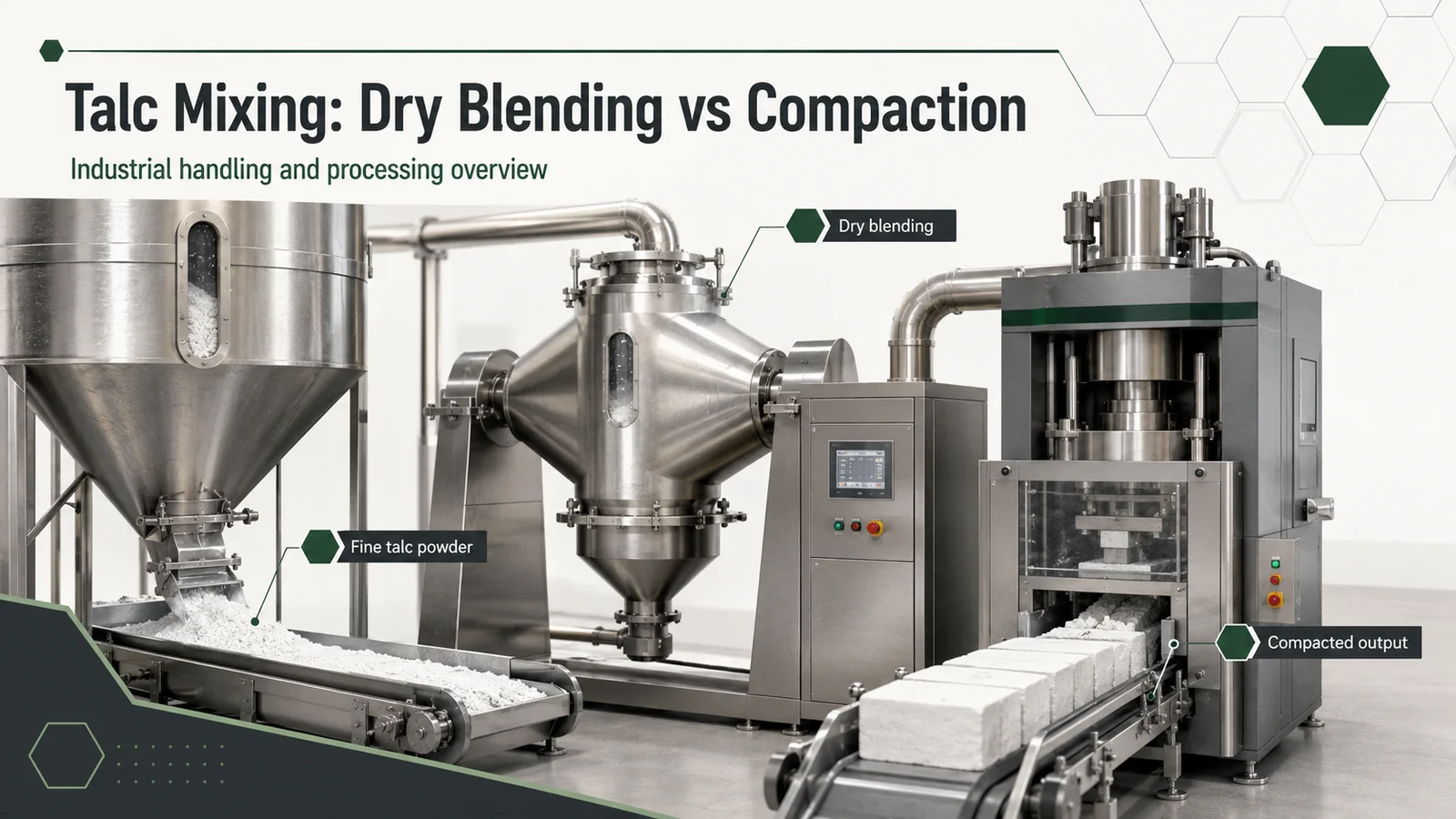
In talc procurement, mixing can describe two different technical routes. The first route is dry blending, where talc remains a powder and is mixed with other powders, additives or grade fractions to reach a defined specification. The second route is compaction, where fine talc powder is mechanically densified, often to improve bulk density, reduce dust behavior and make handling or packing easier.
These routes solve different problems. Dry blending is mainly a formulation and specification-control step. Compaction is mainly a physical handling and densification step. A buyer should not choose between them from price alone.
Dry blending vs compaction: the buyer-level difference
Best when talc must remain a loose powder and be distributed with other powders, grade fractions or additives. The buyer usually cares about uniformity, particle size, moisture, whiteness or chemistry, and segregation risk.
Best when fine talc needs a more controlled physical format. Compaction can support higher apparent density, cleaner handling, reduced airborne fines and more efficient packing when it remains suitable for the downstream application.
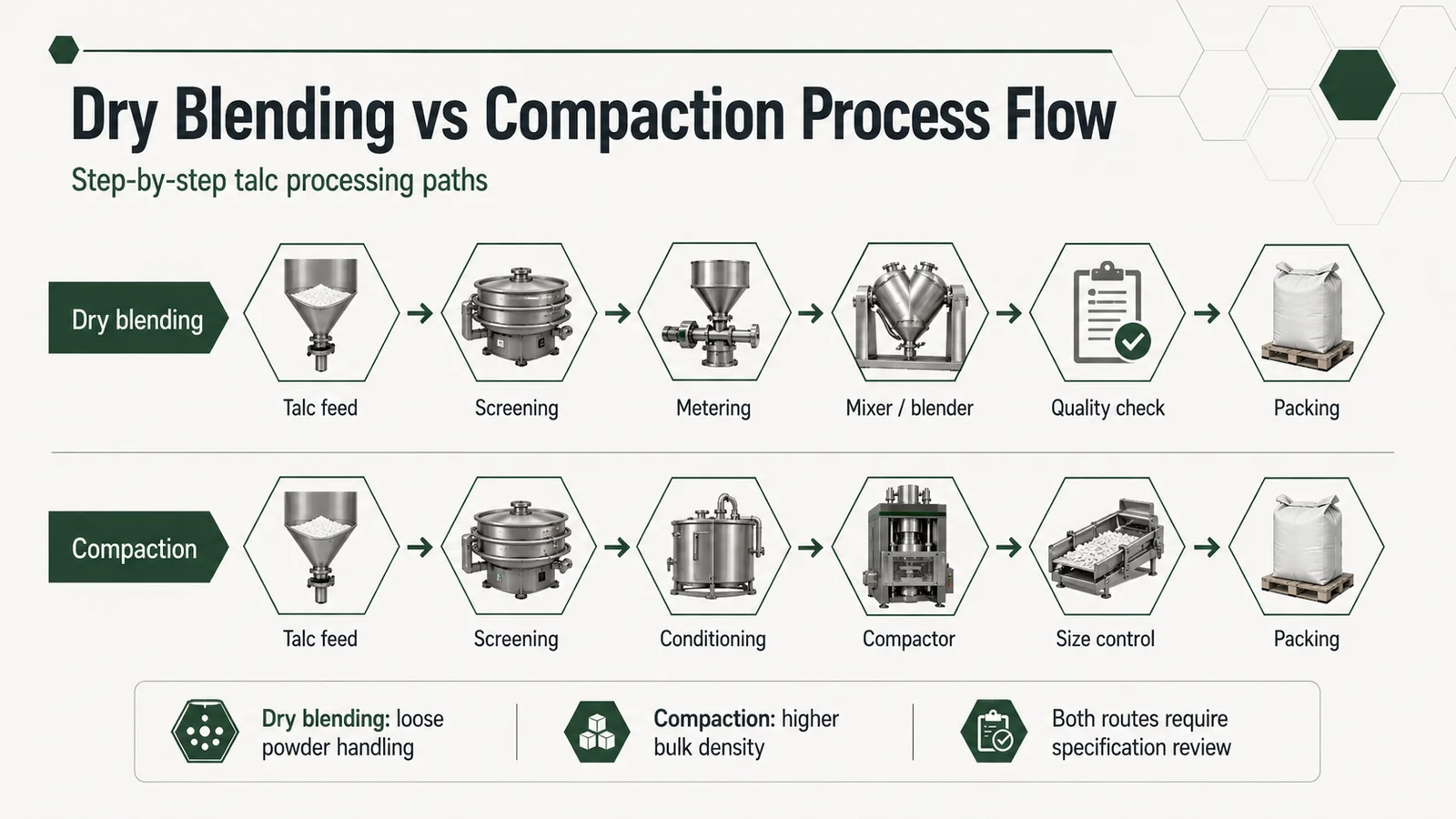
How the two processing paths differ
The dry blending route usually starts with feed review and screening, then moves through metering, blending, quality check and packing. This is useful when the buyer wants the powder route preserved while improving grade distribution or blending consistency.
The compaction route usually starts similarly with feed review and screening, but adds conditioning, compaction and size control before packing. This route is useful when loose powder behavior creates operational problems in handling, storage, dust control or feeding.
Feed review
Check incoming talc data, moisture, particle size, chemistry and intended application.
Route selection
Choose dry blending for powder specification or compaction for handling and density improvement.
Quality checkpoint
Review CoA, MSDS, particle size distribution, bulk density and packaging details.
Shipment preparation
Confirm quantity, packing, destination, Incoterm and documentation scope before release.
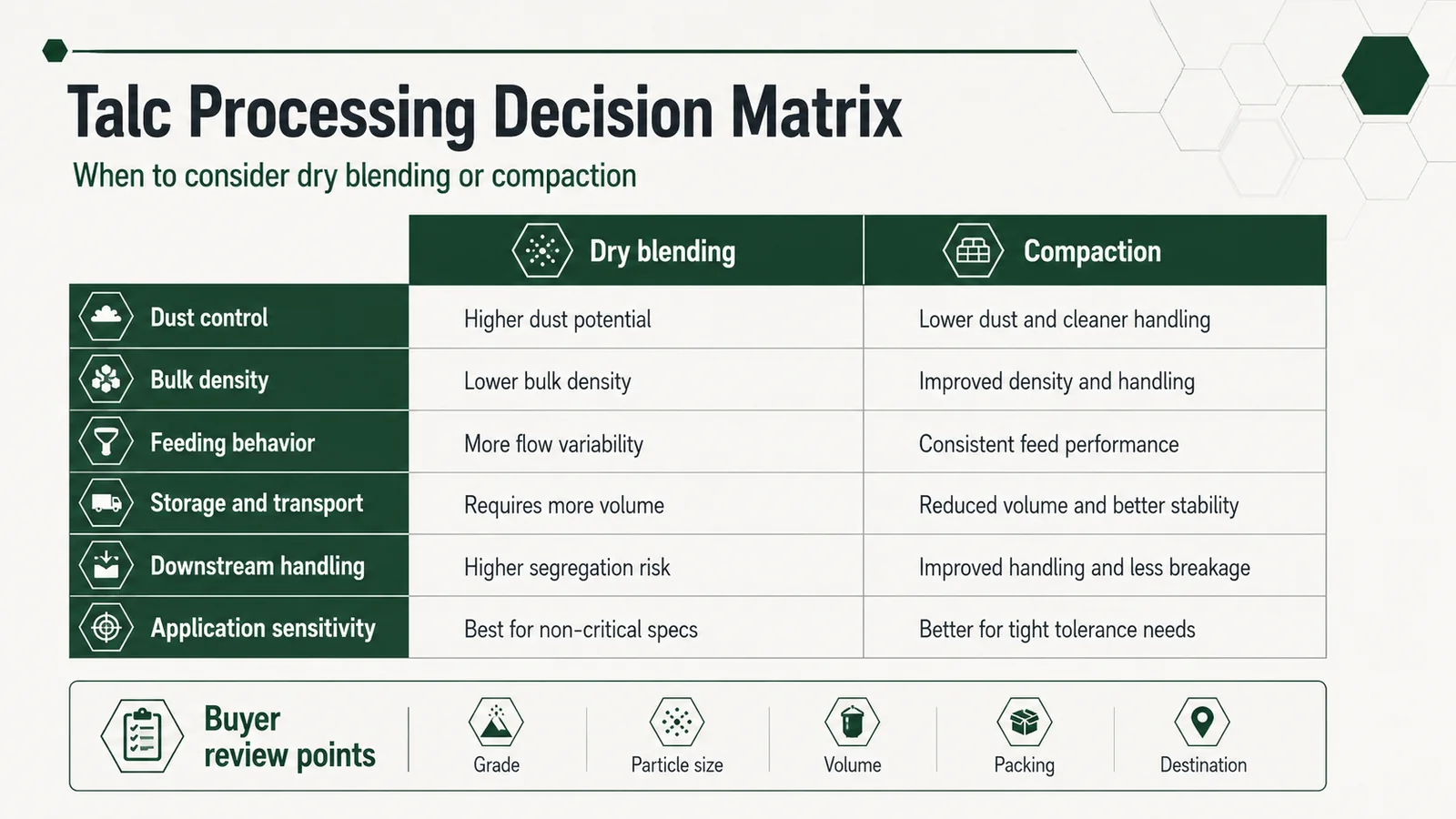
When to choose dry blending
Dry blending is usually the stronger route when the target is powder uniformity or specification alignment. It can be relevant for plastics, paints, coatings, rubber, ceramics, construction compounds and other industrial applications where talc is used as a functional mineral or filler.
- Use dry blending when talc must remain a powder that disperses easily in the buyer’s production process.
- Use dry blending when the main requirement is additive distribution or grade matching.
- Use dry blending when a compacted material could create downstream dispersion problems.
- Use dry blending when the buyer’s internal specification is built around powder properties rather than densified material behavior.
When to choose compaction
Compaction is usually the stronger route when fine talc powder creates handling, storage or shipment problems. Technical dry granulation and roller compaction references describe compaction as a route that can increase bulk density and improve powder handling without a wet granulation step.
- Use compaction when fine powder causes dust during bagging, unloading, conveying or feeding.
- Use compaction when low bulk density increases warehouse volume, handling effort or shipment inefficiency.
- Use compaction when feeding behavior is unstable and a denser material format may improve flow control.
- Use compaction only after checking whether densified talc remains suitable for the final application.
A compacted talc format can solve a logistics or dust problem, but it can create an application problem if the buyer actually needs fast dispersion of a fine powder.
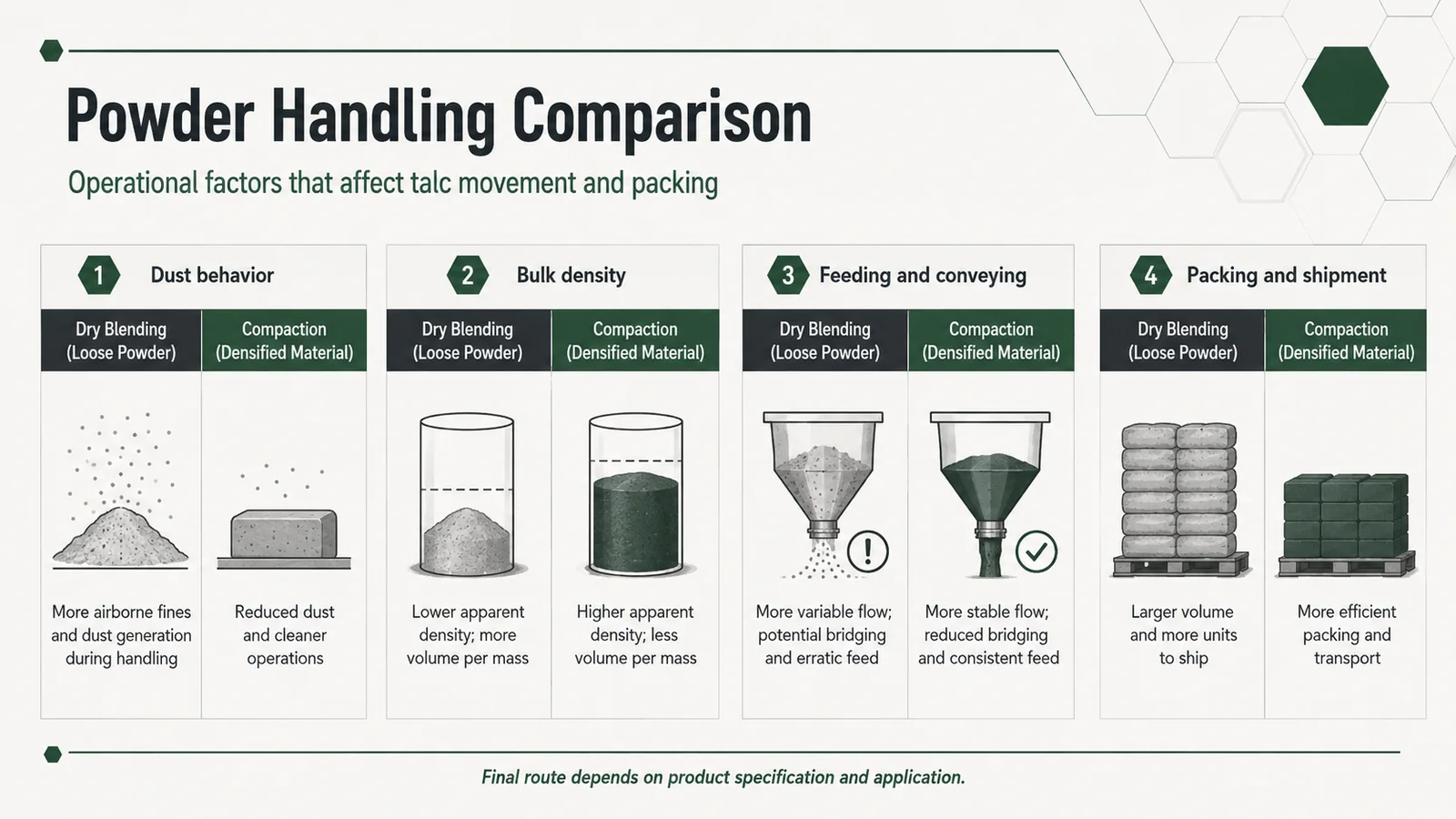
Why dust, density and feeding behavior matter
Fine talc powder can create operational issues when it is discharged, conveyed, mixed, packed or transferred. The buyer’s target is not only a chemical or particle-size specification. The handling route must also be practical for the receiving plant.
NIOSH lists talc under workplace exposure guidance for respirable dust, which supports the need to review dust behavior and handling controls when talc is supplied as a fine powder. Official exposure references do not replace a buyer’s internal safety review, but they show why dust-related specification questions are legitimate in industrial procurement.
Buyer handling questions
- Will the talc be discharged manually, by forklift-handled big bags, by silo or by enclosed feeding system?
- Does the receiving plant need loose powder, or can it accept a densified or granulated material?
- Is the buyer trying to reduce dust at bag opening, transfer, conveying or mixing?
- Will compaction affect dispersion, formulation performance, color, surface behavior or particle-size expectations?
Quality checkpoints before approving either route
A buyer should not approve dry blended or compacted talc only from a product name. A reviewable inquiry should define measurable material properties, intended application, shipment volume and required documents.
Document review before quotation
For AHR procurement, a technical quotation should be linked to the buyer’s grade, quantity, packing, destination and document needs. This reduces vague offers and helps procurement compare material routes on a real shipment basis.
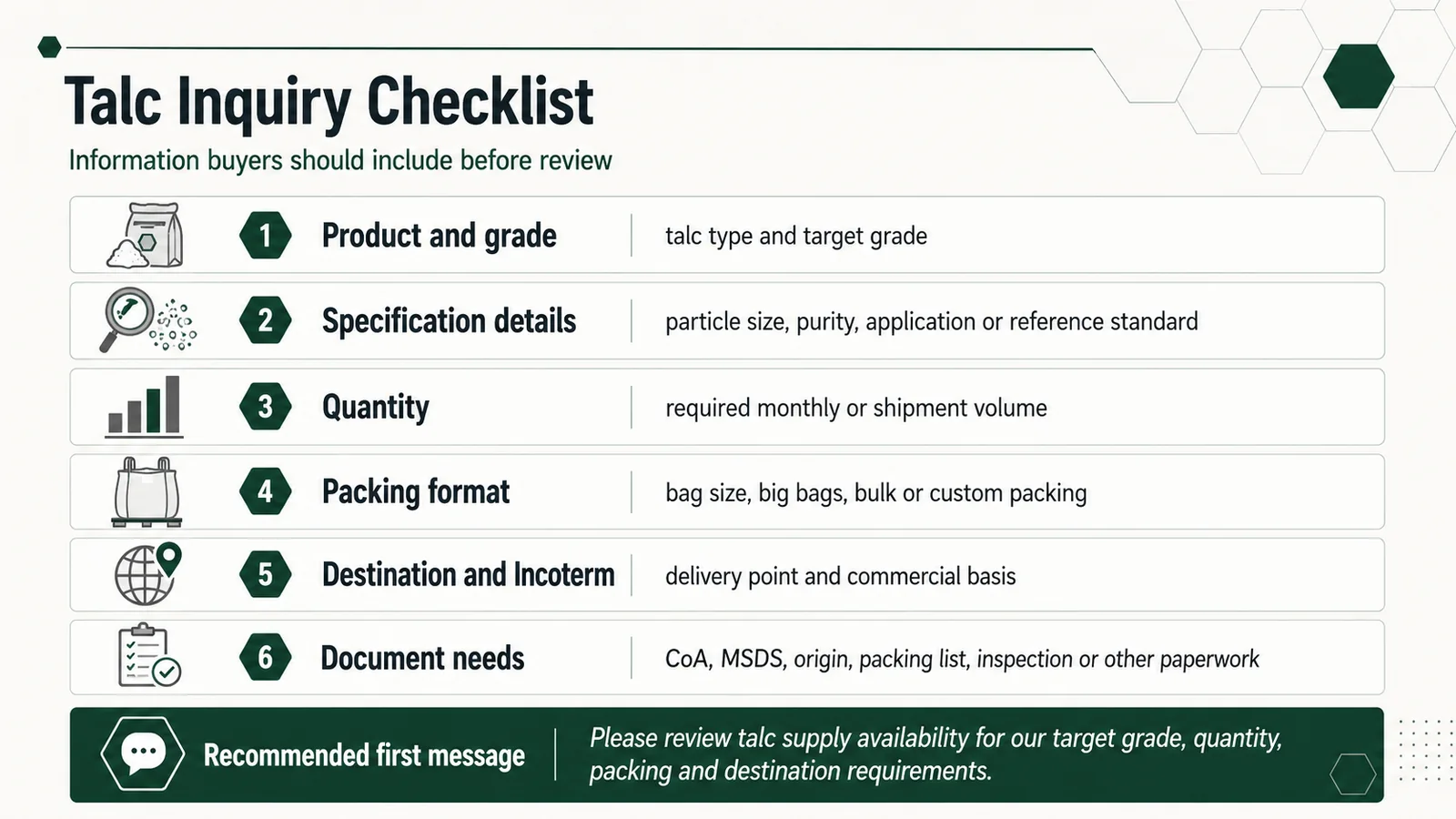
What buyers should send before asking for a quote
A short price request usually leads to an incomplete quotation. For talc dry blending or compaction, the supplier must know the route, grade, handling requirement and shipment basis.
- Product and grade: talc type, target grade, current reference sample or internal standard.
- Specification details: particle size, purity, moisture, whiteness or brightness where relevant, application and reference document.
- Quantity: trial quantity, monthly volume, shipment volume or annual requirement.
- Packing format: bag size, jumbo bags, pallets, container load preference or custom packing.
- Destination and Incoterm: country, port, delivery point, preferred Incoterm and timeline.
- Document needs: CoA, MSDS, origin, packing list, inspection report or third-party testing request.
Sources used for this guide
This article uses official exposure references, technical process references, scientific literature, industry context and internal AHR procurement pages. Trusted source citations are normal crawlable links because they are references, not paid links.
Supports the handling and respirable dust context for fine talc powder. View NIOSH talc page
Supports safety-related context and shows talc exposure limit references across jurisdictions. View NCBI table
Supports the explanation that compaction is used to densify powders and improve handling properties. View scientific review
Supports practical discussion of compaction as a dry route for powder densification and processing control. View technical PDF
Supports process-flow language around blending, compaction, milling and size control. View process guide
Supports the commercial context and internal product path for buyers ready to request specification review. View AHR talc page
How to cite this article
Al Habtoor Resources Technical Review Desk. Talc Mixing: Dry Blending vs Compaction. Al Habtoor Resources Knowledge, 2026. https://habtoorresources.com/talc-mixing-dry-blending-vs-compaction/
Buyer questions about talc dry blending and compaction
Is compacted talc better than dry blended talc?
Not automatically. Compacted talc may be better for dust control, density, packing and feeding. Dry blended talc may be better when the buyer needs a loose powder that disperses easily in the final application.
Does compaction change talc performance?
It can. Compaction changes physical form and may affect dispersion, fines generation, feed behavior and application performance. Buyers should request sample review and process data before approving this route.
What data matters most for talc dry blending?
Particle size distribution, moisture, chemistry, whiteness or brightness where relevant, mixing uniformity, additive compatibility and segregation risk are important review points.
What data matters most for compacted talc?
Bulk density, compacted material size, fines percentage, dust behavior, flow, packing format and post-compaction dispersibility are important review points.
What should a buyer send before requesting talc pricing?
The buyer should send product grade, application, particle size or reference specification, quantity, packing format, destination, Incoterm, required documents and expected shipment timing.
Need talc specified for blending, handling or shipment?
Send the target application, grade, particle size, volume, destination, packing format and required documents. AHR can review the inquiry before quotation and shipment coordination.
Request specification review