
Whiteness vs Brightness – Making Sense of L* a* b*, Ry and R₄₅₇
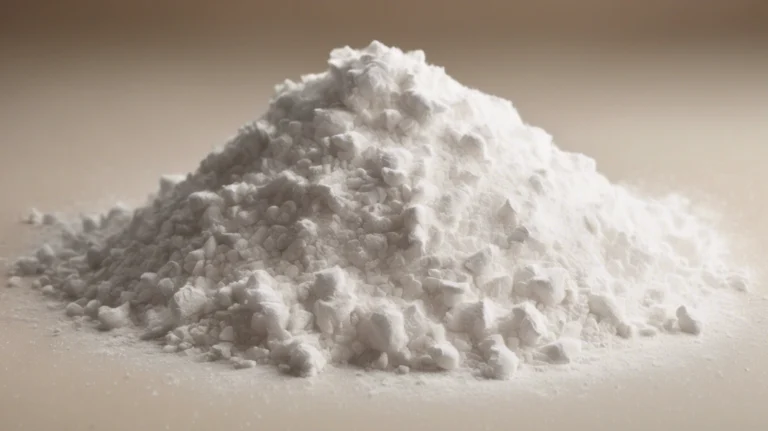
1. Why two words for “how white it looks”?
| Term | What it really asks | Typical units |
|---|---|---|
| Brightness | “How much light does the surface send back?” | A single % value taken at one wavelength (most often 457 nm) |
| Whiteness | “How close is the colour to a perfect, neutral white?” | A pair or trio of colour-space numbers (L*, a*, b*) or an index calculated from them |
A surface can be bright (high reflectance) yet look creamy because it reflects a bit more yellow than blue. That is why industry keeps the two ideas separate.
2. The most common optical metrics you will meet
| Metric shown on a talc COA | How it is obtained | What it tells you |
|---|---|---|
| Ry (also written “Y-brightness”) | Spectrophotometer measures the full visible spectrum, then integrates it with the CIE daylight eye-response curve. | Overall luminance. Higher = brighter. A premium cosmetic talc is usually Ry ≥ 92. |
| L*, a*, b* | Same spectrum as for Ry, but re-expressed in the CIE L*a*b* colour space (D65 illuminant, 10° observer unless stated otherwise). | L* = light/dark (0–100). |
| a* = green ( − ) ↔ red ( + ). | ||
| b* = blue ( − ) ↔ yellow ( + ). | ||
| Neutral white aims for a* ≈ 0, b* ≈ 0. | ||
| R₄₅₇ (ISO/TAPPI brightness) | Instrument shines blue-violet light at 457 nm only and reads the reflectance. | Legacy benchmark for paper pulp and OBA (optical brightener) performance. Rarely quoted for talc fillers. |
| Whiteness indices (e.g., ASTM E313 W, CIE Whiteness 2004) | Software plugs L*a*b* or x y Y values into an equation. | A single roll-up score. Handy for lab discussions, but most fillers are specified by the raw L a b Ry numbers instead. |
3. How the measurements are made – quick sketch
-
Sample is pressed (powder) or cleaned (sheet) to a flat, opaque surface.
-
Spectrophotometer with d/8° integrating sphere (minerals, plastics) or 45°/0° geometry (paper) captures the reflectance curve from 400–700 nm.
-
Instrument software outputs Ry and L*, a*, b* automatically.
-
If a special index is required (R₄₅₇, E313 W, etc.) the program applies the relevant formula.
One scan → all numbers.
4. Interpreting the raw figures
| Value | First-pass verdict |
|---|---|
| Ry > 92 and L* ≥ 97 | Brilliant white – premium cosmetic & colour-critical plastics. |
| Ry 85 – 91 with b* 1.0 – 2.5 | Standard filler white – paints, putties, coated paper. |
| Ry < 85 or b* > 2.5 | Visibly grey/yellow – ceramic, rubber, roofing where colour is secondary. |
| a* | Keep between −1 and +1 for a truly neutral grade. |
Remember: b* is the fastest way to spot yellowing; every +1 shift is obvious to the eye once the background is bright.
5. Which metric should you quote to customers?
| Industry | What buyers usually ask for | Why |
|---|---|---|
| Talc, calcium carbonate, kaolin fillers | L*, a*, b*, Ry | Universally supported; customer can compute any whiteness index themselves if needed. |
| Printing & writing paper | R₄₅₇ brightness, sometimes E313 W | Tradition; optical brighteners are tuned to 457 nm. |
| Textiles, detergents | CIE Whiteness index | Allows direct ranking of OBA efficiency across fabrics. |
For your website datasheets stick to L a b Ry plus the illuminant/observer pair (e.g., “D65/10°”). Add a note that other indices are available on request and can be calculated from the same scan.
6. Key take-aways
-
Brightness (Ry, R₄₅₇) = how much light.
-
Whiteness (L a b or derived indices) = which hue that light has.
-
One spectrophotometer reading gives you everything; the industry publishes the raw L a b Ry quartet because it is transparent and convertible.
-
Checking Ry, L* and especially b* lets you classify a talc grade at a glance – premium cosmetic, general filler, or purely industrial.
Use these principles to read any Certificate of Analysis with confidence, and link out to your Talc Grades by Industry page for application-specific targets.